His own father gives him to Death. After three nights unfed in Death’s house, the boy turns down long life, wealth and wide lands for one answer.
Nachiketa and Yama. Also known as: Nachiketa and Death, Story of the Katha Upanishad.
Tap an underlined word for its meaning.
 Under a thatched pavilion at a great sacrifice, the boy Nachiketa in a white dhoti stands troubled in the foreground while two priests lead four thin, spent cows past the smoking brick fire altar, and his bearded father, a black antelope skin over his shoulder, points sternly back toward his son.
Scene 1 of 9
Nothing left to give
The cows were being led away to the priests.
In his eagerness, Vajashravasa was giving away everything he owned. His son Nachiketa was only a boy. Yet as the gifts went by, faith entered him, and he thought:
These cows have drunk their last water. They have eaten their last grass. They have been milked dry, and their strength is gone. Joyless are the worlds that wait for the man who gives such gifts.
“Father,” he said, “to whom will you give me?”
He asked a second time. He asked a third.
“To Death,” said his father. “I give you to Death.”
 In the dark stone hall of Death’s house, lit by lamps and pale light from the doorway, the boy Nachiketa, a white cloth over his shoulders, looks up at the tall, dark-skinned Yama, who bows his head and greets him with joined palms, a brass water vessel beside him.
Scene 2 of 9
Three nights unfed
“Of many,” said Nachiketa, “I go first; among many, in the middle. What work has Yama, that he will do through me today? Look back at those who went before, ahead at those who follow. A mortal ripens like grain, and like grain is born again.”
Words came to Yama, son of Vivasvat: “A brahmana guest enters a house like fire. Bring water to calm it! Where a brahmana stays unfed, the foolish host loses his hopes, his sacrifices and good works, his sons and cattle.”
Three nights Nachiketa stayed in Death’s house and ate nothing.
Yama spoke to his guest. “Honoured brahmana, salutation to you; may it go well with me. Three nights you stayed in my house unfed. Choose three boons in return.”
 On the polished floor of Death’s lamp-lit hall, Yama kneels and sets a reddish brick on a low altar of bricks, while the boy Nachiketa, kneeling opposite, watches closely and repeats his words.
Scene 3 of 9
Out of death’s mouth
“First, Death,” said Nachiketa, “let my father be calm and kind, his anger towards me gone. When you send me back, let him know me and greet me.”
“Your father, Auddalaki Aruni, will know you as before,” said Yama. “When he sees you freed from the mouth of death, his anger will go, and he will sleep in peace.”
“Heaven holds no fear at all,” said the boy. “You are not there. No one fears old age. Beyond hunger, thirst and sorrow, they rejoice. You know the fire that leads to heaven. Teach it to me; I have faith. That is my second boon.”
Yama taught him the fire that begins the worlds: which bricks, how many, how laid. Nachiketa repeated every word.
 Smiling, Yama holds out a long gold chain set with gems of many colours to the boy Nachiketa, who reaches for it with open hands across the fire now burning on the brick altar.
Scene 4 of 9
Even the gods doubted
Pleased, the great-souled Death spoke again. “I give you a further boon. This fire will bear your name. And take this many-coloured chain. This is your fire, Nachiketa, the fire that leads to heaven. Men will call it yours. Now choose your third.”
“When a man dies, there is a doubt,” said Nachiketa. “Some say he is. Some say he is not. Teach me this. That is my third.”
“Even the gods doubted this, long ago,” said Death. “It is subtle, and not easy to know. Choose another boon, Nachiketa. Do not press me. Let this one go.”
“Even the gods doubted, you say. Hard to know, you say. And no other teacher like you is to be found. No boon is equal to this.”
 In Death’s hall, Yama sweeps his hand toward heaps of gold, horses and elephants in golden trappings, herds of cattle on wide green land, and celestial women in golden chariots playing veena, flute and drum, with one more dancing with cymbals, while the boy Nachiketa stands calm and unmoved.
Scene 5 of 9
Everything but this
Then Death offered him everything else.
“Choose sons and grandsons, each to live a hundred years. Many cattle, elephants, gold, horses. Choose a great domain on the earth, and live yourself for as many autumns as you like. If you hold any boon its equal, choose wealth and long life. Be great on the wide earth, Nachiketa. I will give you a share in every desire.
“Whatever is hard to win in the world of mortals, ask for it, all of it, as you please. These lovely women, with their chariots and their music: no man wins such as these. They are my gift. Let them wait on you.
“Only, Nachiketa, do not question me about death.”
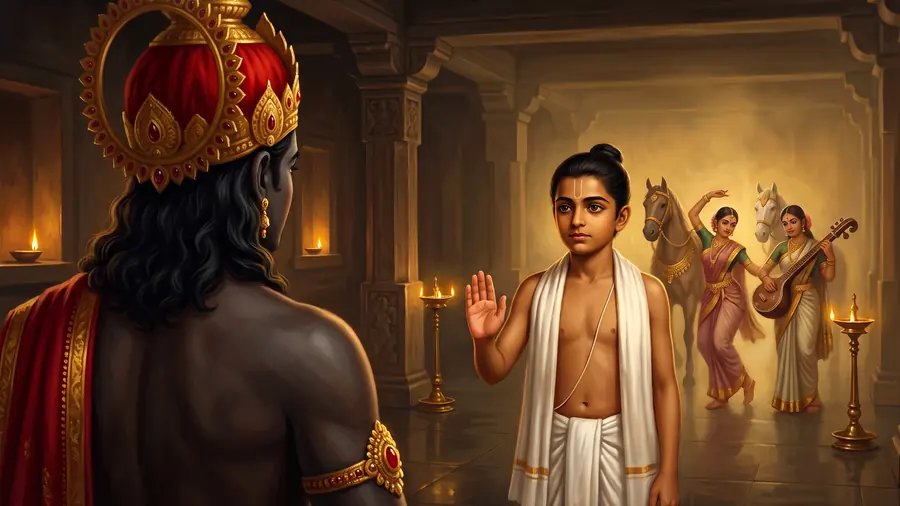
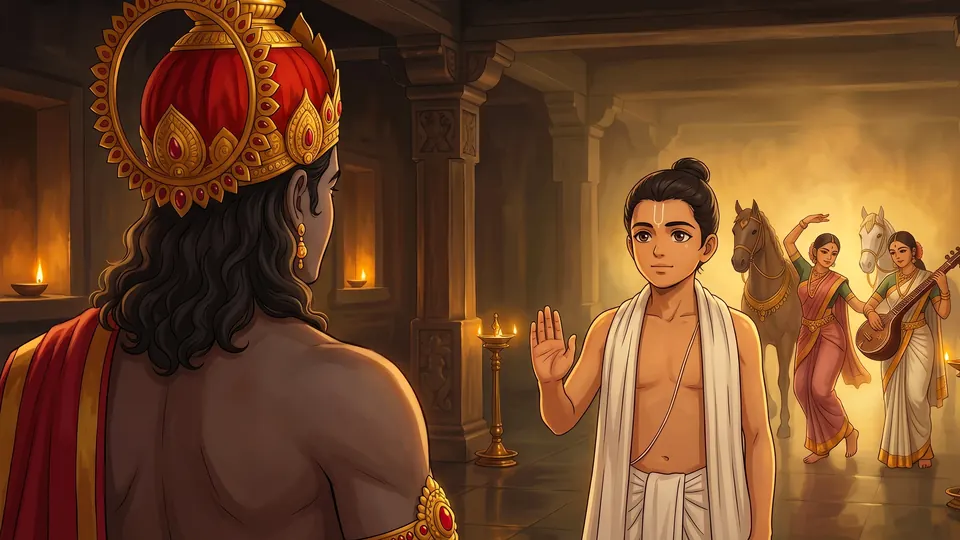
 In Death’s dark pillared hall, seen past the bare, very dark shoulder, red silk cloth and red-capped gold crown of Yama, who stands with his back to us, the boy Nachiketa raises his palm and calmly turns away the gifts, while two horses in gold trappings and two women, one dancing and one playing a veena, wait in the golden haze behind him.
Scene 6 of 9
Keep your horses
“None of this outlives tomorrow, Ender,” said Nachiketa. “It dulls the fire in all of a mortal’s senses, and even a full lifetime is brief. The horses are yours to keep, and so are the dancing and the song.
“No man is satisfied by wealth. Wealth we shall have, now that we have seen you. Life we shall have, as long as you rule. The boon I choose is that one only.
“What mortal, decaying here below, who has come near those who never age and never die, would brood on beauty and pleasure and delight in a long life?
“What men doubt about the great passing, Death, tell us that. This boon goes deep into what is hidden. Nachiketa chooses no other.”
 By the light of a brass lamp, Yama sits on a carved stone seat and teaches with an open hand, while the boy Nachiketa sits cross-legged on the floor before him, listening intently.
Scene 7 of 9
The good and the pleasant
“The good and the pleasant are two different things,” said Death. “Both bind a man, each to its own end. Whoever takes up the good fares well; whoever chooses the pleasant falls short of the goal. Both come to every man. The wise one walks around them, tells them apart, and chooses the good. The dull one chooses the pleasant, to get and to keep.
“You, Nachiketa, weighed every pleasure, the dear and the dear-seeming, and let them all go. You did not take the road of wealth, where so many men go under.
“‘This world, and no other,’ thinks the careless child, blinded by wealth, and falls into my hands again and again. May we always find a questioner like you.”
 Before a wide opening onto a sky of stars and galaxies, Yama speaks with a raised hand, a ring of golden light glowing around it, while a tiny golden light shines in the heart of the seated boy Nachiketa and of a deer and a small bird beside him.
Scene 8 of 9
Not born, never dying
“Then tell me what you see,” said Nachiketa, “apart from and adharma, apart from what is done and undone, apart from what has been and what will be.”
“The word all the Vedas speak,” said Death, “the word every austerity proclaims: in brief, it is Om.
“The knowing Self is not born, and it does not die. It did not come from anything, and nothing came from it. Unborn, eternal, everlasting, ancient, it is not killed when the body is killed.
“Smaller than the small, greater than the great, the Self lies hidden in the heart of every creature. Priest and warrior alike are its rice, and death is the sauce poured over them. Who can say where it is?”
 On a grassy rise, dark-skinned Yama in red and gold and the boy Nachiketa in white watch a golden chariot drive away from them along a winding road toward a blaze of light on the horizon: five white horses abreast, a charioteer in white holding the reins, and a seated rider glowing with golden light.
Scene 9 of 9
Arise, awake
“Know the Self as the rider,” said Death, “and the body as the chariot. The intellect is the charioteer, the mind the reins, the senses the horses, and the things of the senses the roads they run. Without understanding, the mind unyoked, the horses run wild. With understanding, the reins held firm, they obey, and the rider reaches the end of the road: the highest place of Vishnu.
“Arise! Awake! You have your boons; understand them. The say this path is as hard to cross as the sharp edge of a razor.”
Nachiketa received this knowledge from Death, and the whole way of yoga. He reached Brahman. He was free of stain. He was free of death.
You’ve reached the end of this story.
The end
How this story closes
Arise! Awake! You have your boons; understand them.