A princess marries a man with one year to live, and when Yama comes with his noose, she walks after him.
Savitri and Satyavan. Also known as: Savitri Satyavan Katha.
Tap an underlined word for its meaning.
 King Ashvapati, seated bare-chested before a brick fire altar, pours ghee from a long ladle as the golden goddess Savitri rises out of the flames, hand raised in blessing
Scene 1 of 9
Born of ten thousand offerings
For eighteen years Ashvapati, king of the Madras, lived like an ascetic, for he had no child. Every day he poured ten thousand oblations into the fire, chanting to the goddess Savitri, and ate only at the sixth hour.
When the eighteenth year was full, the goddess rose out of the sacred fire in bodily form. “By the Grandsire’s favour,” she said, “a daughter of great energy shall soon be born to you.”
They named the girl after the goddess. She grew like Sree herself, golden as an image, and her splendour burned so fiercely that no man dared ask for her.
“Choose your own husband,” her father told her at last. “Then tell me his name.”
She bowed, and mounted a golden chariot.
 In a pillared palace hall, Savitri in a red and gold sari kneels to touch her father’s feet while he and the white-bearded sage Narada, holding a veena, sit on cushioned seats and look down at her
Scene 2 of 9
Narada’s one word
She came home to find her father with the Narada, and touched both their feet.
“Where has she been?” Narada asked. “Why is she not yet married?”
“That was her errand,” said the king. “Let her tell you.”
“King Dyumatsena of the Salwas went blind,” Savitri said. “An enemy took his kingdom; he went to the woods with wife and infant son. That son, raised in the hermitage, I have accepted in my heart.”
“Alas,” said Narada, “she has unknowingly done a great wrong.” He praised Satyavan: son of truthful parents, who as a boy shaped horses from clay; bright as the sun, forgiving as the earth.
“And his defects?” asked the king.
“Only one. Within a year from today, Satyavan will die.”
 On a palace terrace at sunset, Savitri stands with palms joined and a resolute face while her father looks up in wonder at Narada, holding his veena, rising into the glowing clouds
Scene 3 of 9
Only once
“Go, Savitri,” the king said. “Choose another.”
“Death falls only once,” she answered. “A daughter is given away only once. Only once does a man say, I give. Short life or long, with virtues or without them, I have chosen my husband. I will not choose twice. First the mind decides, then the tongue speaks, then the hand acts. So it is with me.”
Narada turned to the king. “Her heart does not waver. Nothing will turn her from this path. No other man has the virtues of Satyavan. I approve this gift.”
Then he rose into the sky and was gone.
Ashvapati took his daughter into the sacred forest, where a blind king sat on kusa grass beneath a sala tree.
 Savitri, thin and grave in bark cloth and a red upper cloth, sits on kusa grass outside a thatched hermitage hut at misty dawn, palms joined, her gold bangles and necklace set aside on a leaf beside her
Scene 4 of 9
Bark instead of ornaments
“We live as ascetics here,” Dyumatsena said. “How will your daughter bear the forest?”
“She knows, as I do, that joy and sorrow come and go,” Ashvapati answered. The two kings joined the couple with due rites, and Ashvapati went home glad.
The moment her father left, Savitri took off every ornament and put on bark and red cloth. She tended her mother-in-law, honoured the blind king like a god, and made Satyavan happy.
But Narada’s words never left her, night or day. She counted.
When his death lay four days off, she began a fast of three nights. “That vow is very hard,” the blind king said.
“Perseverance carries a vow through,” she said, and grew thin as a wooden doll.
 Savitri, in bark cloth and a red upper cloth, watches with grave tenderness as Satyavan, a young man with shoulder-length wavy hair and an axe on his shoulder, walks ahead on a riverside path and points out two peacocks beneath flowering trees
Scene 5 of 9
Today is that day
The sun stood two hands high. Today is that day, Savitri thought. She fed the fire and bowed to the brahmanas and Satyavan’s parents. The hermits blessed her: may you never be a widow. So be it, she said in her heart.
“Your vow is done. Eat now,” said Satyavan’s parents.
“I will eat when the sun goes down.”
Satyavan shouldered his axe for the woods.
“Don’t go alone. I am coming with you.”
“You have never walked those paths, and the fast has weakened you.”
“I feel no weariness.” The blind king let her go. She had never before asked for anything.
Satyavan showed her rivers, flowering trees, peacocks. She smiled, and watched him as a man already dead.
 In a forest glade Satyavan lies with his head in Savitri’s lap beside his axe and cut branches, as Yama, dark, crowned and red-robed, stands in blazing light holding a coiled noose
Scene 6 of 9
The one with the noose
He filled his wallet with fruit and began cutting branches. Sweat came. Then his head ached.
“Savitri, my head feels pierced with darts. I must sleep. I cannot stand.”
She sat and took his head into her lap, and counted the hour, the moment.
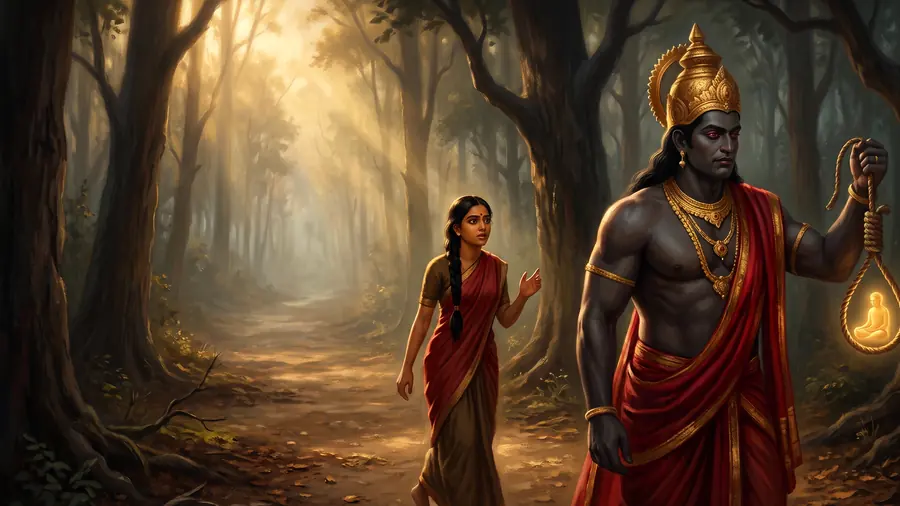
Then she saw him. A man in red, a diadem on his head, huge and blazing like the sun, dark of skin and red of eye, a noose in his hand, gazing steadily at Satyavan.
She laid her husband’s head down and rose, trembling. “You are a god. Who are you?”
“You are devoted and rich in austerity, so I speak with you. I am Yama. His days are done. Such a man is not for my messengers. I came myself.”
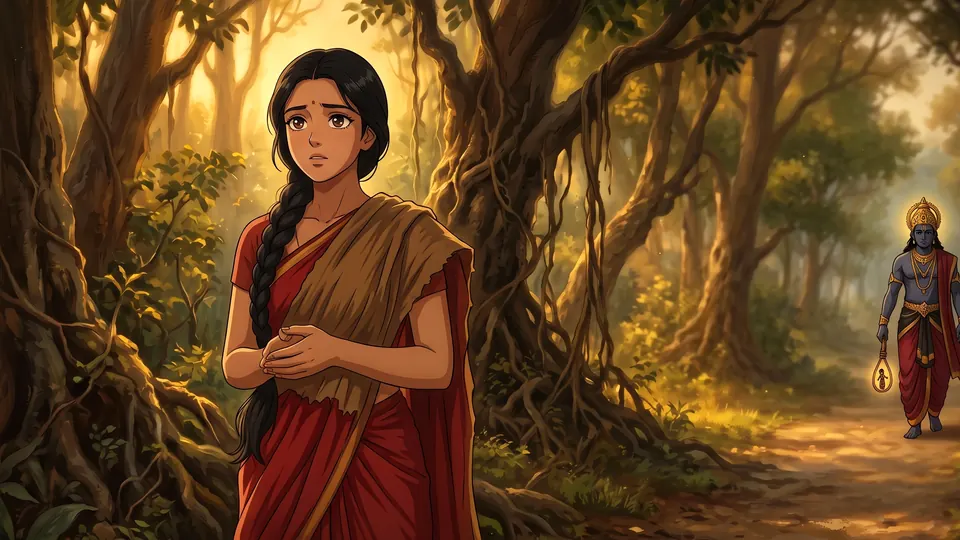
 On a misty forest road, Savitri follows dark, crowned, red-robed Yama, speaking to him with a raised hand, as a tiny glowing figure, Satyavan’s soul, hangs bound in the loop of the rope noose he holds up
Scene 7 of 9
Seven steps together
Yama drew out of Satyavan’s body, by force, a being the size of a thumb, bound fast in the noose. The body lay without breath, without lustre. Yama turned south.
Savitri followed.
“Go back. Perform his funeral rites. You have come as far as anyone may.”
“Where my husband is taken, there I follow. That is the eternal way. The wise say seven steps taken together make two friends. As your friend, hear me.” And she spoke to him of .
“Your words please me. Ask a boon, anything but his life.”
“Give my blind father-in-law his sight.”
“Granted. You are tired. Go back.”
“How can I be tired beside my husband?” She spoke again, and won a second boon: the blind king’s lost kingdom.
 Savitri, palms joined and tears on her cheeks, faces dark, crowned Yama as he unties the knot of his rope noose and a tiny glowing figure, Satyavan’s soul, rises free between them
Scene 8 of 9
Without him, no heaven
Yama walked on. Savitri walked on, and spoke.
“As water to the thirsty,” Yama said, and granted a third boon: a hundred sons for her sonless father. Still she followed. “Beside my husband I do not feel the length of the road.” He granted a fourth: a hundred sons born to her and Satyavan.
“It is the righteous whose truth makes the sun move across the sky,” she said.
“Now ask an incomparable boon.”
“You gave me a hundred sons. That cannot come true without my husband. Without him I want no happiness, no heaven, no wealth. Let Satyavan live, and your own word will be true.”
“So be it,” said Yama, son of Vivasvat, and untied his noose. “He will live four hundred years.”
 By moonlight among fireflies, Savitri, her hair tied up and his axe in her hand, walks Satyavan home with his arm across her shoulders, his fruit bag left hanging on a branch behind them
Scene 9 of 9
With sight or without
She went back and took his head into her lap. Satyavan woke, gazing at her again and again, like a man come home from a far land.
“I have slept so long. Where is that dark one who was dragging me away?”
“Gone. Rise. The night is deep.” Jackals shrieked. She tied up her hair, hung his wallet on a bough, took his axe, and with his arm across her shoulder led him home by moonlight.
In the hermitage, a blind king could see. That night he and his wife had searched for their son. Savitri told the everything.
At sunrise people came from Salwa. His own minister had slain the usurper. “With sight or without,” they had cried, “he shall be our king!”
You’ve reached the end of this story.
The end
How this story closes
“With sight or without,” they had cried, “he shall be our king!”