Nine heads given to the fire, a mountain lifted, a name from Shiva, and a king who would not give Sita back.
Ravana’s story. Also known as: Ravana and Kailasa.
Tap an underlined word for its meaning.
 Ravana kneels with joined palms beside a sacred fire on the Gokarna shore, his ten crowned heads whole again, as four-faced Brahma appears on a lotus in the glowing sky.
Scene 1 of 12
Nine heads in the fire
The night he was born, jackals with flaming mouths circled to the left, the sun lost its light, and the calm ocean heaved. Kaikasi had borne a son with ten heads. His father named him Dashagriva, Ten-necked.
At Gokarna he fasted for ten thousand years. At the end of each thousand he cut off a head and gave it to the fire. Nine were gone, his hand on the tenth, when Brahma appeared.
“Ask.”
“Let no god, demon, serpent or yaksha be able to kill me.” Men he left off the list. He counted them as straw.
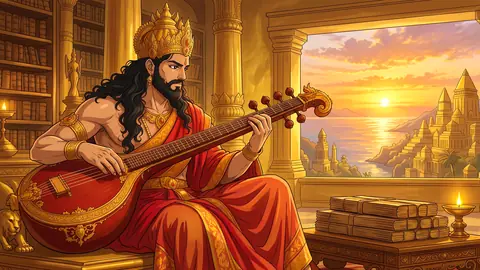
The heads rose back out of the flames. In time Lanka was his: golden towers above the sea, and Vedic chant at dawn.
 Ten-headed Ravana, braced in a wide stance, heaves the tilting flank of snowy Kailasa upward with both arms raised, while Shiva sits calm on the summit and a frightened Parvati clings to him, the flying chariot Pushpaka in the sky.
Scene 2 of 12
The mountain in his arms
Pushpaka, the flying chariot, stopped dead in the air above a mountain.
A dwarfish attendant with a shaven head stood leaning on his spear. Nandi. “Turn back, Ten-necked one. Shankara is at play on this mountain. No one may approach.”
“Who is this Shankara?” Dashagriva leapt down from Pushpaka. He saw Nandi’s monkey face and laughed like bursting clouds.
“You mock my form,” said Nandi. “Monkeys with my form and strength will be born to destroy your race.”
Dashagriva did not even hear. “I will tear this mountain up by its roots.”
He set his arms beneath and lifted.
The mountain shook. Shiva’s attendants shook. Parvati trembled and held fast to her lord.
Shiva, as if in play, pressed down with his toe.
 On a mountain ledge under a starry dawn sky, Shiva holds out the glowing sword Chandrahasa to Ravana, who kneels with head bowed and open hands.
Scene 3 of 12
The name of a scream
The whole weight of came down on his arms.
He screamed. The cry went through three worlds. The sea rose wild, the hills shook, and his own ministers thought it was the thunder that ends the universe.
“Bow to the blue-throated lord,” they urged. “We see no other refuge.”
So, arms still pinned, he bowed his heads and sang. Hymn after hymn, for a thousand years. One of them, later tradition says, was the Shiva Tandava Stotram.
At last Shiva released him. “Your cry struck terror through the three worlds and set them shaking. Your name shall be Ravana.”
Ravana asked for a weapon. Shiva gave him a blazing sword, Chandrahasa. “Never treat it lightly. If you do, it returns to me.”
 In Lanka’s golden throne hall, veiled Shurpanakha flings out an accusing hand toward Ravana, who frowns on a throne wreathed in flame among four seated ministers.
Scene 4 of 12
His sister in the hall
He sat on a golden throne among his ministers, blazing like fire on an altar drenched in ghee. His chest still bore scars from Indra’s thunderbolt and the tusks of Airavata.
Shurpanakha came in, her nose and ears cut away by Lakshmana, and spoke before them all.
“You are drunk on pleasure and blind to danger. One man, Rama, has killed fourteen thousand of us in Janasthana. Khara is dead. Dushana is dead. And you know nothing.”
“Who is this Rama? What weapon does he carry?”
“I never saw him draw. I never saw him release. I saw only our army falling like a crop under hail.”
Then she spoke of his wife. “Sita. No goddess, no gandharva woman is her equal. Take her.”
 At a seaside hermitage, the frightened old ascetic Maricha sits on a deerskin with palms joined as Ravana stands over him pointing, his golden chariot on the beach behind.
Scene 5 of 12
The old demon’s warning
In secret Ravana took his chariot across the sea to the hermitage where Maricha lived in bark and deerskin.
“Become a golden deer with silver spots. Draw Rama and his brother away. I will take Sita.”
Maricha’s mouth went dry. He joined his palms. “When Rama was not yet twelve, one arrow of his threw me a hundred yojanas into the ocean. Now I see Rama behind every tree. Words that begin with ‘ra’ frighten me. Ratna. Ratha.”
“I did not ask your advice,” said Ravana. “Do it, or die now by my hand.”
“Then I will die at Rama’s hand, not yours.”
Before Rama’s hermitage a deer stepped out: gold, dappled with silver, its antler tips like sapphire.
 High above the forest and the Godavari, the great bird Jatayu flies at Ravana from the left, while Ravana, gripping the crying Sita in her saffron sari, raises a sword against him and the wreck of his golden chariot falls below.
Scene 6 of 12
The vulture king
Ravana threw off his disguise as a wandering holy man. He seized Sita, and the golden chariot rose.
She cried to the karnikara trees, to the Godavari, to every bird and beast below: “Tell Rama that Ravana is carrying off Sita!”
On a tree, an old vulture opened his eyes. Jatayu.
“I am sixty thousand years old,” he said. “You are young, armoured, a bowman in a chariot. Still, while I live you will not take her.”
He struck. He broke Ravana’s bow, then a second. He tore away the armour, felled the mules, smashed the chariot. Ravana rose again with Sita in his grasp, and Jatayu came after him, wings spread wide.
Ravana had one weapon left. He raised his sword.
 In the Ashoka grove before dawn, Sita sits on the bare ground beside a single blade of grass as Ravana gestures toward her, lamp-bearing women behind him and Hanuman watching from a tree.
Scene 7 of 12
A blade of grass
Before dawn, music woke him. He came into the Ashoka grove with a hundred women carrying golden lamps. High in a tree, a monkey watched.
Ravana stood before Sita and spoke. “Do not be afraid. I will not touch you against your will. This single braid, this bare ground, this fasting do not suit you. Be first among my queens. My kingdom is yours. I am yours.”
Sita set a blade of grass on the earth between them and spoke across it.
“Turn your mind back to your own wives. I am Rama’s, as sunlight belongs to the sun. If you want to live, make Rama your friend.”
“Two months,” said Ravana. “Then you share my bed, or you die.”
 Hanuman stands with his arms bound by ropes before Ravana on a gleaming crystal throne, while an older minister in green leans in beside the king and three counsellors look on.
Scene 8 of 12
The envoy in ropes
Indrajit’s Brahma weapon brought the monkey down. Hanuman let himself be bound with hemp and bark. He wanted to see this king.
He saw him on a crystal throne, pearls blazing on his chest, four counsellors at his side, like a rain cloud on Meru’s peak.
Hanuman could only stare. “What form. What courage. What strength. What splendour. If he were not so strong in unrighteousness, he could guard heaven itself, Indra and all.”
A suspicion came over Ravana. Was this Nandi, who had cursed him the day he shook ?
At Ravana’s word his chief minister, Prahasta, spoke gently. “Do not be afraid. Did Indra send you? Kubera? Yama? Tell the truth and you will be released.”
“I am the messenger of Rama.”
 Vibhishana rises into the dawn sky above Lanka with palms joined and a sorrowful face, four companions flying behind him, as an angry Ravana flings out an arm from a palace terrace below.
Scene 9 of 12
One brother leaves
At dawn Vibhishana walked into his brother’s palace, through Vedic chant raised for Ravana’s victory.
“Since Sita came, the sacred fire will not blaze, though fed with mantras. Snakes coil where the fire is kept. The cows’ milk curdles. Give her back.”
Ravana would not hear it. In council Vibhishana said it again: give Sita back to Rama.
“One can live beside an enemy, or an angry snake,” said Ravana, “but not beside a foe who calls himself a friend. Anyone else who said this would be dead. Shame on you!”
Vibhishana rose into the sky with four companions, mace in hand.
“You are my elder brother, and an elder brother is like a father. But these words I cannot bear. Be happy without me.”
 In a vast torchlit chamber, the giant Kumbhakarna stirs groggily on his couch as tiny guards beat drums and blow conch shells around him.
Scene 10 of 12
The sleeper wakes
An arrow split Ravana’s crown. “You are weary,” said Rama. “Go. Rest. Come back.”
On his throne Ravana said, “All my penance was wasted. I asked protection from gods and demons. Of men I said nothing. Wake Kumbhakarna.”
Drums, conches, crags and trees hurled at him. A thousand elephants ran over him, and he stirred. Then hunger raised the giant.
Kumbhakarna heard his brother out and laughed. “This is what we warned of in council. Vibhishana was right. Still, what a brother must do, I will do.”
He went out to battle. Rama’s arrow brought him down like a mountain into the sea.
Ravana fell senseless. Waking, he wept: “My right hand has fallen. What is a kingdom to me now? What is Sita?”
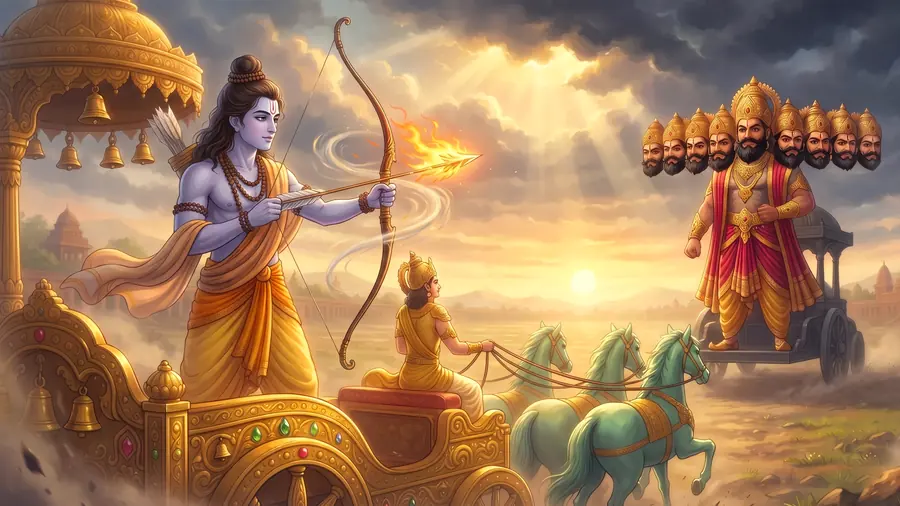
 Rama stands on Indra’s golden chariot, driven by Matali behind green horses, and draws a blazing divine arrow toward ten-headed Ravana on his dark chariot across the battlefield.
Scene 11 of 12
Like nothing but itself
Indra sent his own chariot for Rama, hung with bells, its pole of cat’s-eye gems, its green horses held by the charioteer Matali.
The sky can be compared only to the sky, the ocean only to the ocean, and the battle of Rama and Ravana only to itself.
Rama cut off a head. Another rose in its place. A hundred times. They fought for seven days, with no rest by day or night.
“Use the weapon of Brahma,” said Matali. “The time has come.”
In its feathers lived the wind. At its point, fire and sun. In its weight, Mount Meru. The earth trembled as Rama fitted it.
It struck Ravana’s chest. His bow slipped from his hand. The king of Lanka fell.
 On the dusty battlefield at dusk, Vibhishana kneels with both hands on the shoulder of Ravana, who lies still with eyes closed, while Rama stands nearby with one hand raised and sacred fires glow in earthen pots.
Scene 12 of 12
The tree has fallen
Vibhishana knelt by his brother in the dust.
“You, who belonged on the highest beds, why do you lie on the ground? A great tree has fallen: firmness its shoot, endurance its blossom, austerity its strength, valour its root. The storm that was Rama has brought it down.”
“He did not fall without fighting,” said Rama. “A warrior who dies in battle is not to be mourned.”
“He gave to those who begged,” said Vibhishana. “He kept the sacred fire. He mastered the Vedas. Let me do for him what must be done.”
“Enmity ends with death,” said Rama. “Our purpose is fulfilled. Let his rites be performed. He is as much mine as yours.”
The sacred fires went before Ravana in earthen pots.
You’ve reached the end of this story.
The end
How this story closes
“Enmity ends with death,” said Rama.