A sonless king holds a great sacrifice. The gods gathered at it need a man to end Ravana, and Vishnu chooses that king for his father.
The birth of Rama. Also known as: Ram Janm Katha, Putrakameshti Yajna.
Tap an underlined word for its meaning.
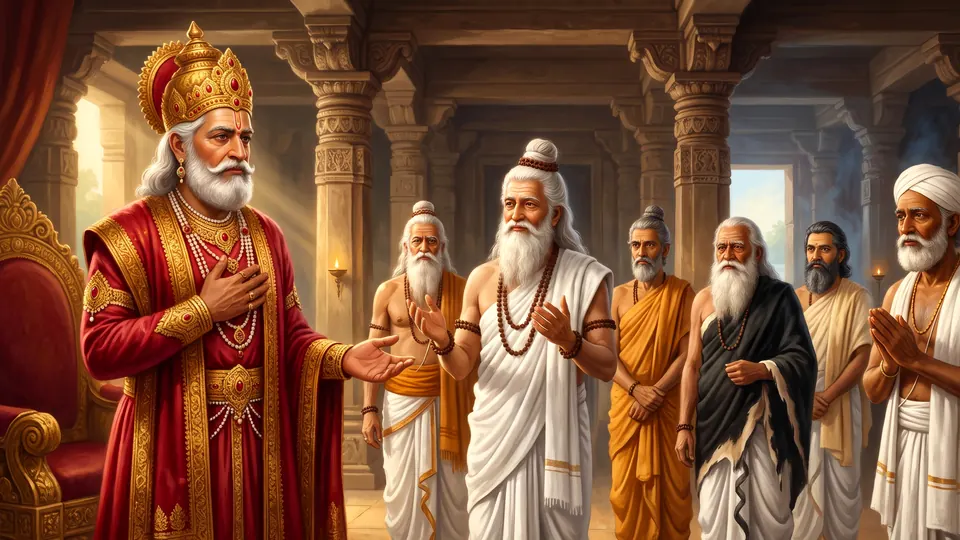 In a pillared stone hall, the white-bearded King Dasharatha in red and gold stands by his throne, hand on his heart, as Vasishtha in white, four priests and Sumantra in a white head-cloth hear his resolve.
Scene 1 of 9
A king with no son
It burned in Dasharatha. A great king, wise in , and no son to carry on his line.
Then a thought: why not the horse sacrifice?
“Sumantra, bring my teachers and priests.”
They came: Suyajna, Vamadeva, Jabali, Kashyapa, and Vasishtha, the family priest.
“Without a son I have no peace,” the king told them. “I will offer the horse sacrifice.”
“Well said!” they answered. “Let the horse go free. Prepare the ground on the Sarayu’s north bank. You will have the sons you long for.”
The king went to his queens. “Take the vow. I sacrifice for sons.”
Their faces opened like lotuses when the cold season ends.
But Sumantra had heard an old story. Alone with the king, he told it.
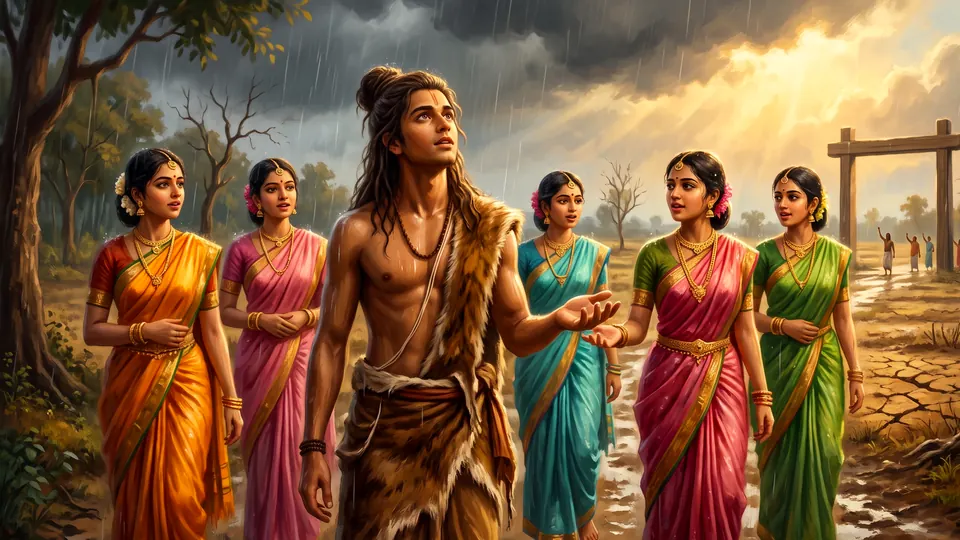 Rain breaks over parched, cracked fields as the young forest sage Rishyashringa, in a spotted hide, looks up in wonder while five women in bright saris walk beside him, singing, with a timber gate and rejoicing villagers in the distance.
Scene 2 of 9
The sage who brought rain
The holy Sanatkumara once told it to the .
In the forest lived Rishyashringa, a ’s son, who had never seen a man or woman of any town. Then drought struck Anga. King Romapada sent singing women with sweets to lead him out; he took the sweets for fruit. He came, and so did the rain. Romapada gave him his daughter, Shanta.
“Sanatkumara foretold more,” said Sumantra. “A king named Dasharatha will bring this to his sacrifice, and have four sons. Go for him yourself.”
With Vasishtha’s leave, Dasharatha went to Anga and found the beside Romapada, blazing like fire. He brought the pair home through streets sprinkled, perfumed, hung with flags.
They lived there happily a long while. Then came spring.
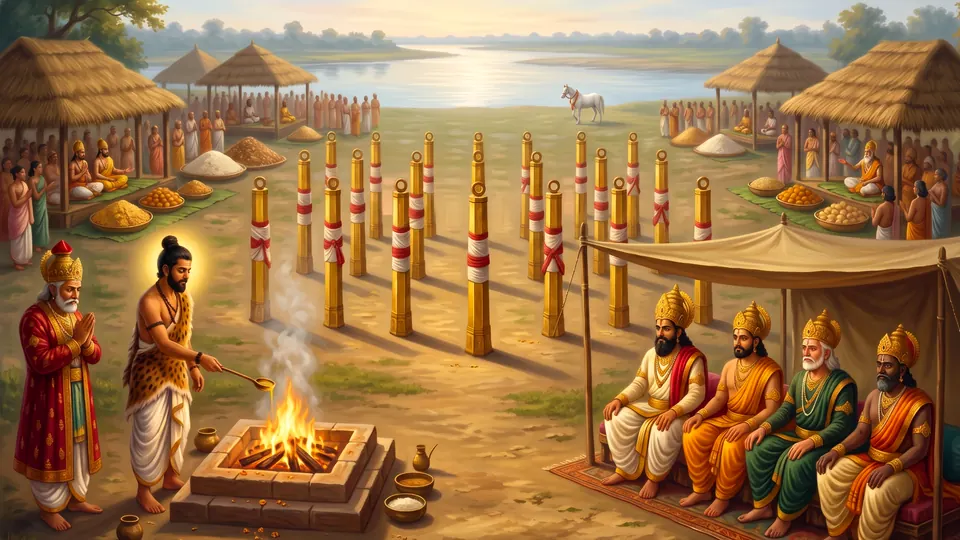 On the bank of the Sarayu, the young sage Rishyashringa pours ghee into a square brick fire as King Dasharatha stands beside him with joined palms; behind them stand twenty-one gilded, cloth-wrapped posts in three rows of seven, four crowned kings sit under a cloth canopy, food lies in heaps, and a white horse stands free by the river.
Scene 3 of 9
The horse comes home
Dasharatha bowed his head before Rishyashringa and chose him to lead the sacrifice.
“Let the horse go free,” said the . “You will have four sons,” the priests promised, “of boundless valour.”
A year went by. Spring came again, and with it the horse. Vasishtha had kings invited: Janaka of , the king of Kashi, the old king of Kekaya, Romapada of Anga.
On the Sarayu’s north bank the began. No one went tired. No one went hungry. Food stood in heaps like mountains. Twenty-one gilded posts, wrapped in cloth, shone like the seven in the sky.
At the end the king gave his priests the earth itself.
They gave it back. “We live for the Veda. You alone can guard the earth.”
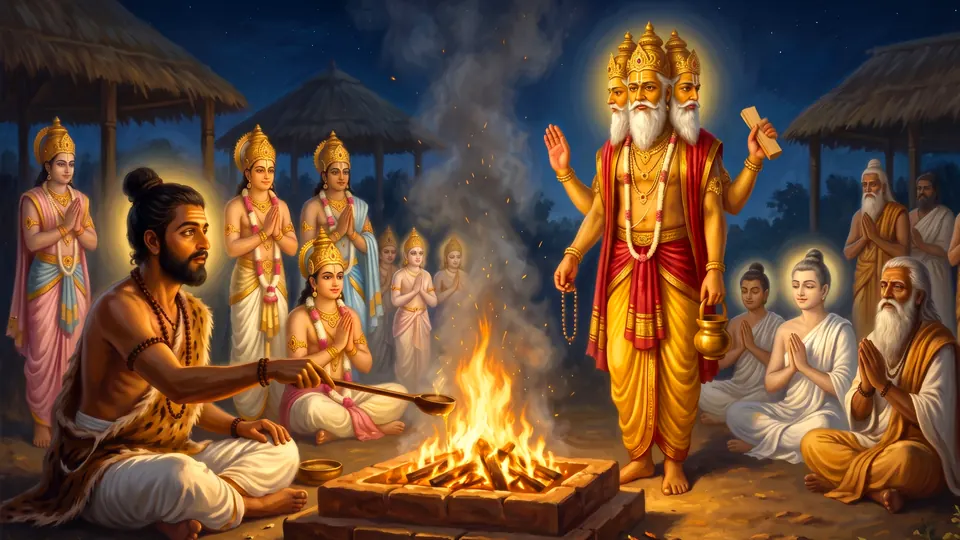 At night by the sacrificial fire, Rishyashringa pours an offering while crowned gods, haloed siddhas and bearded sages with joined palms gather round the four-faced, four-armed Brahma, who stands in red and gold with one hand raised.
Scene 4 of 9
A gap in the boon
“Now let my line grow,” Dasharatha asked Rishyashringa.
“Four sons will be born to you,” said the . He thought a moment, then began the for sons with Atharva mantras, pouring offerings into the fire.
Gods, gandharvas, siddhas and great gathered for their shares, and the gods turned to Brahma.
“Lord, by your boon the rakshasa Ravana torments us all. The sun does not scorch him. The wind does not blow near him. The sea, garlanded with waves, does not stir when it sees him. Find a way to end him.”
Brahma thought. “He asked that no god, gandharva, yaksha or rakshasa could kill him. Men he did not deign to name. By a man he can die.”
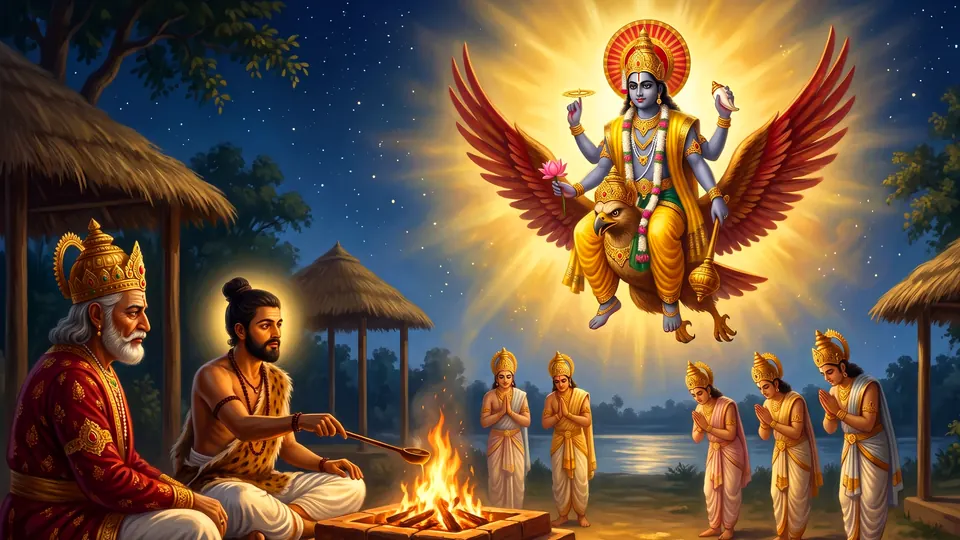 Under a starry night sky, slate-blue four-armed Vishnu in yellow, holding discus, conch, lotus and mace, rides down on golden-brown Garuda in a blaze of light as five crowned gods bow with joined palms, while King Dasharatha and the young sage Rishyashringa sit at the sacrificial fire.
Scene 5 of 9
Vishnu chooses a father
Just then Vishnu came on Garuda, blazing, in yellow garments, conch, discus and mace in hand. The gods bowed and praised him.
“For the good of the worlds, make yourself fourfold. Be born to King Dasharatha’s three queens as his sons. Become a man, and kill Ravana, whom the gods cannot.”
“Do not fear,” said Vishnu. “I will kill Ravana in battle, with his sons and grandsons, ministers and kin. Then I will live among men ten thousand years, and ten hundred more, guarding this earth.”
“By what means?” he asked, though he knew.
“In a human body,” said the gods.
The Lord chose Dasharatha for his father. And at that very hour, the sonless king was offering the for sons.
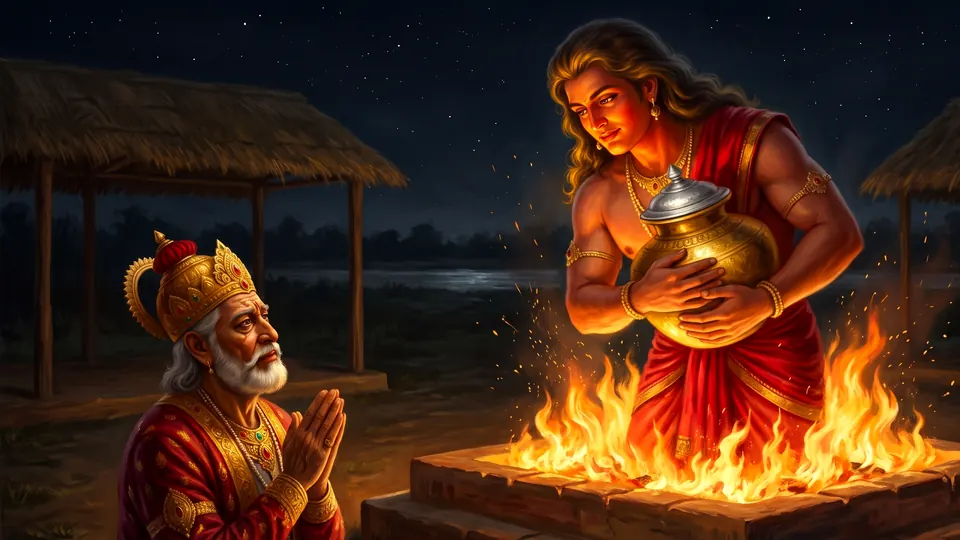 At night, a towering red-robed figure with a flowing mane of hair rises from the flames of a brick altar, cradling a gold vessel with a silver lid in both arms, as the white-bearded King Dasharatha looks up at him with joined palms.
Scene 6 of 9
The vessel of gold
Out of the fire rose a being of matchless radiance, tall as a mountain peak: robed in red, red-faced, his voice like a drum, his hair soft as a lion’s mane. He had a proud tiger’s valour and shone like a blazing flame. In both arms, as a man holds a beloved wife, he carried a great vessel of gold, lidded with silver, full of the gods’ payasa.
“Know me, king, as one sent by Prajapati.”
The king joined his palms. “Welcome, lord. What shall I do?”
“Take this payasa, made by the gods. Give it to your queens to eat. Through them you will have the sons you seek.”
Dasharatha bowed his head, and the vessel of gold passed into his hands.
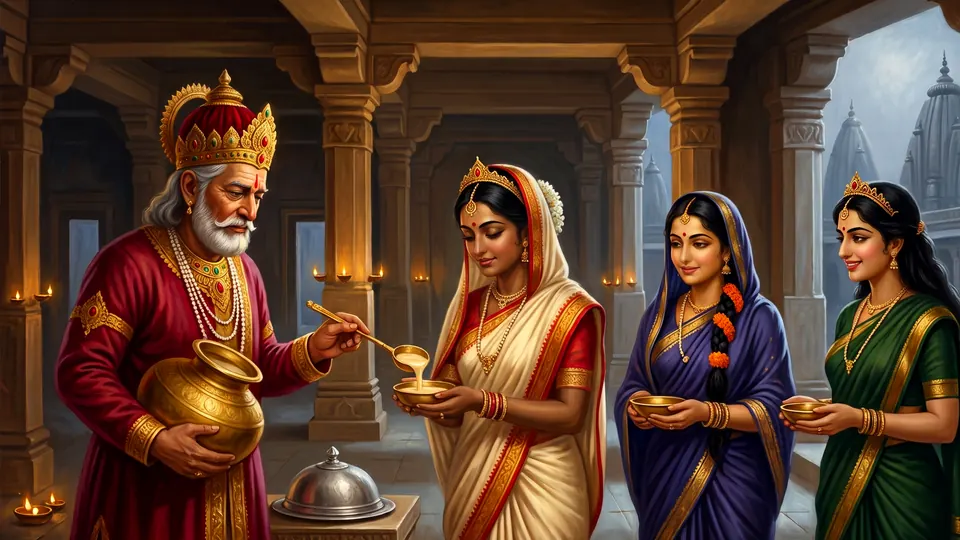 In a lamp-lit pillared hall, King Dasharatha ladles payasa from a gold vessel into the bowl of Kausalya in an ivory sari, while Sumitra in indigo and Kaikeyi in dark green wait smiling with their own gold bowls.
Scene 7 of 9
Half, and half again
He walked round the being in reverence, glad as a poor man handed a fortune, and the being vanished. Joy lit the queens’ palace as autumn moonlight fills the sky.
The king went straight to Kausalya. “Take this payasa. It will give you a son.”
Half he gave to Kausalya. Half of what was left, to Sumitra. Half of what remained, to Kaikeyi. The last share, after thinking a while, he gave to Sumitra again.
The queens ate, honoured and glad. They glowed like fire and sun, and soon they carried children.
The sacrifice ended. The gods, the kings, and Rishyashringa with Shanta went home.
Six seasons turned. Then came the twelfth month, Chaitra, and its ninth day.
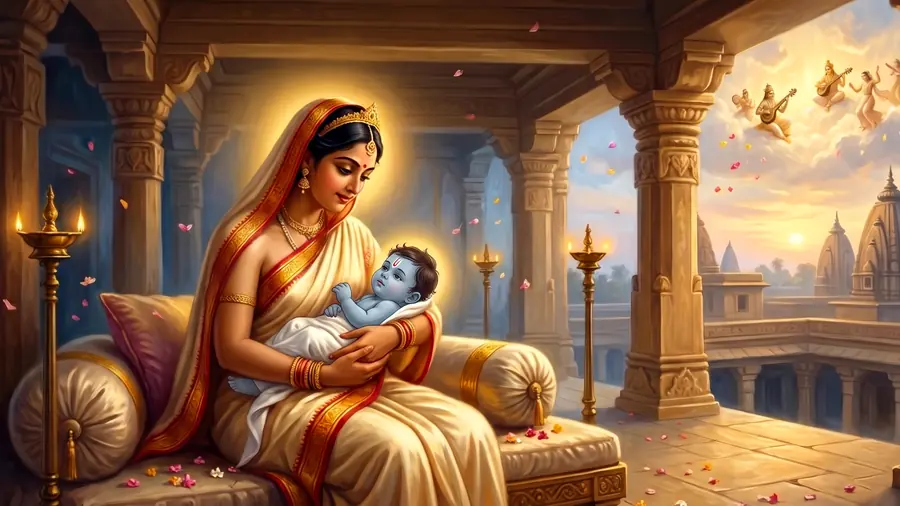
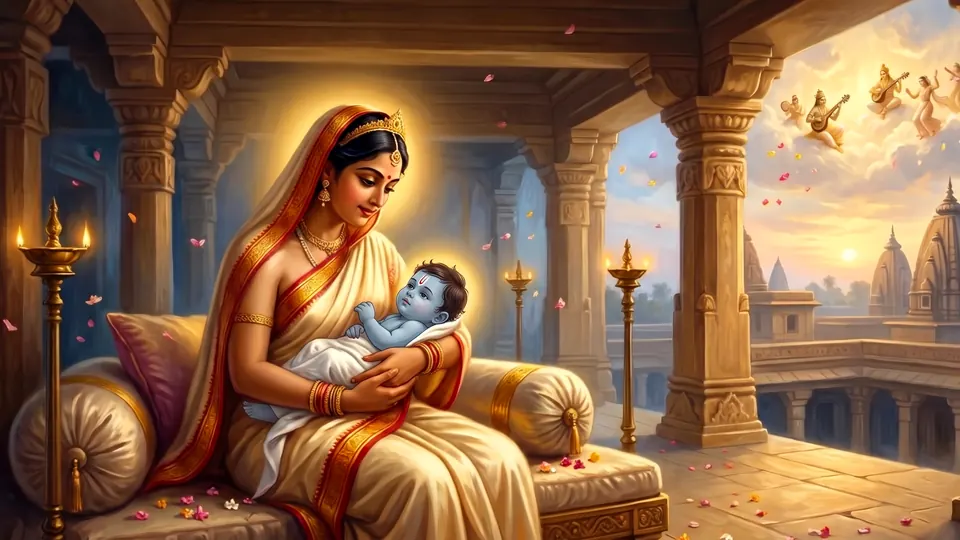 At dawn in a pillared palace chamber, Queen Kausalya in an ivory and red sari sits on a cushioned couch gazing down at the blue-skinned newborn Rama in her arms, while petals fall and tiny celestial musicians and dancers appear in the clouds above Ayodhya’s temple towers.
Scene 8 of 9
Born under Punarvasu
The star was Punarvasu, Aditi’s own. Five planets stood exalted. Cancer was rising, Jupiter rising with the moon.
Kausalya gave birth to Rama, lord of the world, honoured by all the worlds, marked with every sign of greatness: eyes tinged red, long arms, red lips, a voice like a drum. She shone with him as Aditi shone with Indra, the thunderbolt-bearer.
Kaikeyi bore Bharata, true in his valour, under Pushya, with Pisces rising. Sumitra bore Lakshmana and Shatrughna, heroes skilled in every weapon, under Ashlesha, the serpent’s star, with Cancer rising and the sun up.
Gandharvas sang. Apsaras danced. The drums of the gods sounded, and flowers fell from the sky. ’s streets filled with actors, dancers, singers and players.
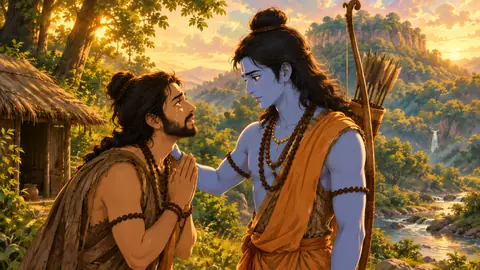
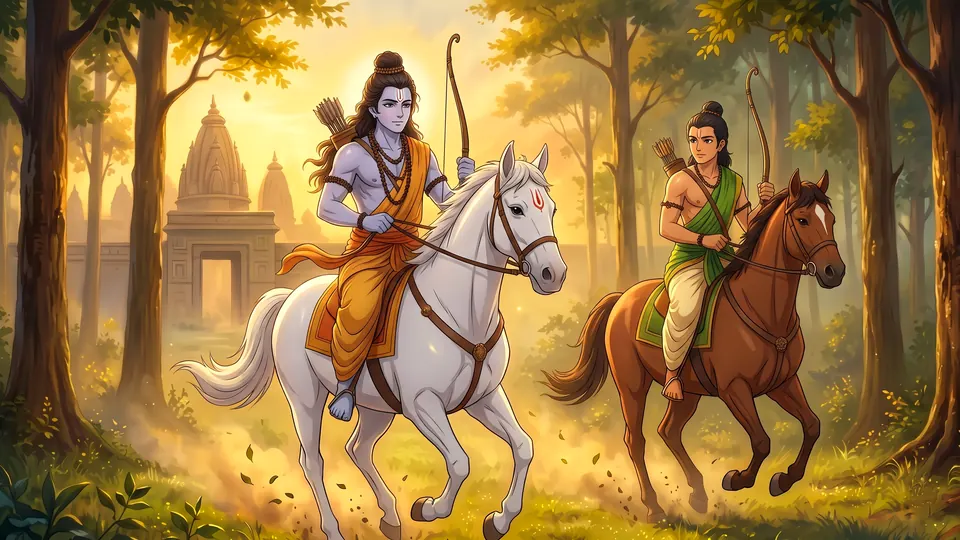 In a sunlit forest outside Ayodhya, the young Rama, a red-and-white tilak on his brow and his long wavy hair in a top-knot, rides a white horse with his bow in his hand, and the young Lakshmana in green follows close behind on a brown horse, also holding his bow.
Scene 9 of 9
His breath outside his body
Eleven days later a joyful Vasishtha named them: the eldest Rama; Kaikeyi’s son Bharata; Sumitra’s sons Lakshmana and Shatrughna.
All four grew learned in the Veda, brave and wise. But Rama rose above them like a banner, his father’s delight, dear to all as the spotless moon. He mastered elephant, horse and chariot, loved the bow, and served his father.
From childhood Lakshmana was devoted to him, like Rama’s own breath moving outside his body. Rama would not sleep without him, nor eat without him. When Rama rode out to hunt, Lakshmana followed close behind, bow in hand.
And Shatrughna was dearer than life to Bharata, and Bharata to him.
Then the king, with his priests and kin, began to think of their marriages.
You’ve reached the end of this story.
The end
How this story closes
From childhood Lakshmana was devoted to him, like Rama’s own breath moving outside his body.