One throw at a time, a king loses everything, then his queen asks the hall a question.
Draupadi Cheer Haran. Also known as: the game of dice, Dyut Sabha, Draupadi Vastraharan.
Tap an underlined word for its meaning.
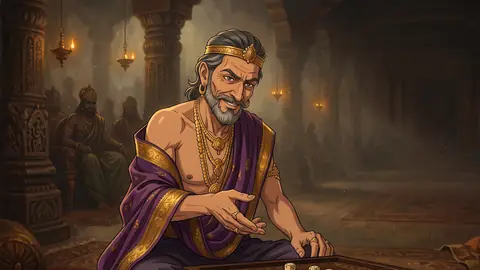
 In a sunlit pillared hall, Duryodhana stands with a hand on his chest beside Shakuni, who holds the dice at a carved board, while Yudhishthira sits across from them with his back to us.
Scene 1 of 9
Let the dice be cast
The assembly hall was full. Kings sat on carpeted seats. Shakuni, son of Suvala, spoke to the eldest son of Pandu. “O king, everyone has been waiting for you. Let the dice be cast and the rules be fixed.”
“Deceitful gambling is sinful,” said Yudhishthira. “There is no Kshatriya prowess in it. Do not defeat us like a wretch, by tricks.”
Shakuni had an answer. Every contest, he said, is entered to win: the strong against the weak, the skilled against the unskilled. “If you are afraid, desist.”
“Summoned, I do not withdraw,” said Yudhishthira. “That is my vow. With whom shall I play?”
Duryodhana spoke up. “I will supply the wealth and the jewels. My uncle will throw for me.”
 Shakuni tosses the dice from a raised hand with a sly grin as a troubled Yudhishthira watches, pearls and small gold jars on the board and two white-bearded elders seated behind.
Scene 2 of 9
A chariot hung with bells
Behind the kings sat Bhishma, Drona, Kripa and Vidura, their hearts heavy. Yudhishthira laid down his first stake: ocean pearls set in pure gold. Shakuni took up the dice, cast them, and said, “Lo, I have won!”
“You won that unfairly,” said Yudhishthira. “Let us play for thousands.”
He staked jars of gold, each holding a thousand nishkas. Then his royal chariot, covered in tiger-skin, hung with little bells that clattered like thunder, drawn by eight horses white as moonbeams. Then a hundred thousand serving-girls; then thousands of serving-men. Then a thousand elephants with tusks like plough-shafts, and Shakuni laughed as he won them. Then the horses Chitraratha had given Arjuna.
Each time the dice rolled. Each time the same voice: “Lo, I have won!”
 Before a sunset window, Vidura raises his hand in warning to the blind king on his throne while Duryodhana scowls with folded arms behind him.
Scene 3 of 9
A jackal in the house
As play went on, Vidura turned to the blind king. “Listen, O king, though my words are bitter as medicine to the dying. At his birth Duryodhana cried like a jackal. A jackal lives in your house in the form of Duryodhana, and you do not see it.”
He spoke of honey-gatherers so lost in honey on a dangerous height that they never see the fall. “We all know Shakuni’s skill at play. Let him go back where he came from.”
Duryodhana turned on him. “We have cherished you like a serpent in our lap, Kshatta. You always praise our enemies. Go where you please.”
“A true friend speaks what is bitter but healing,” Vidura answered, and bowed. No one listened. The dice rolled again.
 Yudhishthira kneels stunned at the dice board as his four brothers stand behind him with heads bowed, and Shakuni smiles in the foreground with dice in his hand.
Scene 4 of 9
Brothers on the board
“You have lost much,” said Shakuni. “Is anything left?”
There was. Yudhishthira staked his cattle and flocks from the Parnasa to the Sindhu. Then his city, his land and all its people, all but the Brahmanas. Each throw: “Lo, I have won.”
Then he staked Nakula, and lost him. Then Sahadeva, and lost him.
“The sons of Madri are mine,” said Shakuni. “But it seems Bhima and Arjuna are dearer to you.”
“Wretch!” said Yudhishthira. “You seek to divide us, who are of one heart.”
Then he staked Arjuna, who carried them like a boat across the sea of battle. Lost. Then Bhima, foremost of all who wield the mace. Lost. Then himself.
The dice fell. Lost.
 The blind king sits on his throne with a glad smile, gripping its arms, while Vidura sits beside him with his head in his hands and Bhishma and Drona stand behind in dismay.
Scene 5 of 9
One stake still unwon
“You lost yourself while wealth remained,” said Shakuni. “That is sinful.” Then he turned back. “One stake dear to you is still unwon. Stake Krishna, the princess of Panchala. Win yourself back with her.”
Yudhishthira staked Draupadi, and as he staked her he spoke of her: her curling blue-black hair, her eyes like autumn lotuses, the queen who slept last and woke first and cared for everyone, down to the cowherds.
“Fie! Fie!” cried the elders. Bhishma, Drona and Kripa broke into sweat. Vidura sat with his head in his hands. But the blind king, glad at heart, kept asking, “Has the stake been won?” Karna and Dushasana laughed aloud.
Shakuni cast. “Lo, I have won!”
 In her chamber, Draupadi in a red sari raises her palm with an indignant look, sending her question back as a messenger bows with joined hands.
Scene 6 of 9
Whom did you lose first?
“Bring her here, Kshatta,” Duryodhana told Vidura. “Let her sweep our rooms with the serving-women.”
“She was staked after the king had lost himself,” Vidura answered. “In my judgement, she is no slave.”
Duryodhana sent the messenger, the Pratikamin. “What prince stakes his wife?” Draupadi asked him. “Go, ask that gambler whom he lost first, himself or me.”
Yudhishthira sat as if bereft of reason and answered nothing, good or ill.
“Let her come and ask it herself,” said Duryodhana. The messenger went again. Draupadi sent word: she would do what the elders, knowing , decided. The hall sat silent.
“Bring her,” Duryodhana ordered again. Afraid of her anger, the messenger only asked the hall what to tell her. “Dushasana,” said Duryodhana. “You go.”
 In a shaft of light in the great hall, Draupadi, her hair loose, raises her hand to question the court as Dushasana grips her hair and Bhishma sits silent with downcast eyes.
Scene 7 of 9
Dragged by the hair
Dushasana strode into the Pandavas’ rooms with blood-red eyes. “Come, princess of Panchala. You have been won.”
Draupadi rose, rubbed her pale face, and ran toward the women of Dhritarashtra’s household. He roared and caught her by her long hair, hair that had been sprinkled with sacred water at the Rajasuya. He dragged her into the hall, and she trembled like a plantain tree in a storm.
Bent double, she cried, “I am in my season. I wear a single cloth.”
“Season or not, cloth or none,” he said, “you are our slave now.”
Before the whole court she asked why Bhishma and Drona sat silent, and whether she had been won. Bhishma answered, “Morality is subtle. I cannot decide the point you have put.”
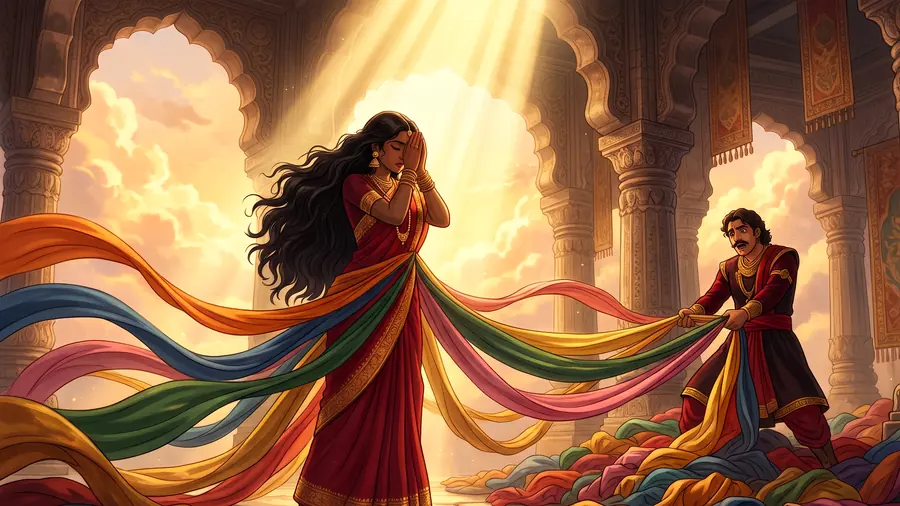
 Under a beam of golden light, Draupadi presses her joined hands to her face with eyes closed as Dushasana pulls an endless stream of many-coloured cloth from her sari, a heap of cloth piling on the floor.
Scene 8 of 9
Robes without end
Vikarna declared her not won. Karna, beside himself with anger, answered, “Dushasana, strip the Pandavas, and her too.” The five brothers threw down their upper cloths. Dushasana seized Draupadi’s garment and pulled.
She covered her face and cried out: “O Govinda! O Keshava, do you not see the Kauravas shaming me? Save me, Krishna. I am sinking in the Kaurava sea!”
Krishna heard her and was moved. Unseen, covered her. Each robe dragged away revealed another beneath it, hundreds upon hundreds, of many hues.
Bhima, lips quivering, swore before every king: “If I do not tear open this wretch’s breast in battle and drink his blood, let me never reach my ancestors.”
Cloth lay heaped on the floor. Dushasana sat down, tired and ashamed.
 Bhima, bare-chested in an ochre dhoti with a maroon sash, grips his round golden mace, its head resting on the floor, as he swears his vow with blazing eyes amid rising sparks and flames; Duryodhana, crowned, sits in the foreground seen from behind.
Scene 9 of 9
Two boons, not three
Duryodhana bared his left thigh to Draupadi. Bhima’s red eyes widened. “Let me never reach my ancestors if I do not break that thigh in the great battle.” Sparks seemed to fly from him, like a burning tree.
Then, in the king’s sacrificial chamber, a jackal cried out, and asses brayed in answer. Gandhari and Vidura told the blind king what it meant. “Wicked Duryodhana,” said Dhritarashtra, “destruction is already upon you.” He turned to Draupadi. “Ask any boon.”
“Free Yudhishthira, so no one calls my son a slave’s child.” “So be it.” “Free my husbands, with their chariots and bows.” “So be it. Ask a third.”
“Greed destroys virtue,” said Draupadi. “Free again, my husbands will win prosperity by their own deeds.”
You’ve reached the end of this story.
The end
How this story closes
“Greed destroys virtue,” said Draupadi.