Two cousins reach Dwaraka on the same day and find Krishna asleep. One may take his army of ten crores. The other gets Krishna, unarmed.
Krishna, or his army. Also known as: Narayani Sena, Arjuna chooses Krishna.
Tap an underlined word for its meaning.
 A long cloud of golden dust rises behind a small party of riders and a light chariot racing along a sandy coast road toward the white, flat-roofed city of Dwaraka shining by the sea.
Scene 1 of 7
Two cousins, one city
The priest had gone. He had been sent to Hastinapura, the city named after the elephant, and after him messengers were sent to the kings of many countries. One errand Arjuna kept for himself. He set out for Dwaraka.
Krishna and Balarama had left for Dwaraka, and with them, by hundreds, went the Vrishnis, the Andhakas and the Bhojas.
None of it stayed hidden. Duryodhana, the royal son of Dhritarashtra, had secret emissaries who brought him word of everything the Pandavas did. He learned that Krishna was on his way. He took a few troops, and fine horses with the speed of the wind, and went.
He reached Dwaraka, the beautiful city of the Anarta land. That very day, Arjuna arrived too.
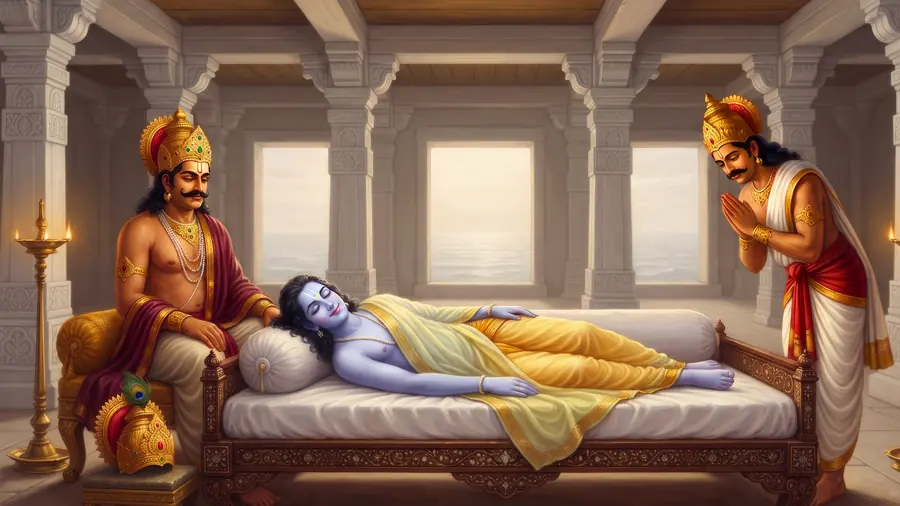
 Krishna sleeps on a low carved bed in a white pillared chamber in Dwaraka; Duryodhana sits on a fine gold seat at its head and Arjuna, in his diadem, stands at its foot bowing with joined hands.
Scene 2 of 7
The sleeper
Krishna was asleep.
That was what the two Kuru princes, tigers among men, found when they arrived. The one they had both hurried to Dwaraka to see lay on his bed, sleeping. They drew near him as he lay.
Duryodhana entered the room first. There was a fine seat at the head of the bed, and he sat down on it.
After him came Arjuna, the wearer of the diadem. He stood at the foot of the bed, bowing, his hands joined.
Tellers often say Duryodhana took the head out of pride. The epic says only this: a fine seat stood there, and he sat.
One sat at the head. One stood at the foot. Between them, Krishna slept on.
Then he woke.
 Krishna has just woken and his eyes turn first to Arjuna, who stands at the foot of the bed with joined hands, while Duryodhana sits silent on the gold seat at the head.
Scene 3 of 7
The first glance
Krishna’s eyes opened, and fell first on Arjuna.
He asked them both whether their journey had been safe. He greeted each of them as was fitting. Then he asked what had brought them.
Duryodhana answered with a cheerful face.
“Lend me your help in the coming war. Arjuna and I are equally your friends, and you are bound by the same tie to us both. But today I was the first to come to you. Right-minded men take up the cause of the one who comes to them first. So the ancients acted. And you, Krishna, stand at the very top of the right-minded in this world, and are always honoured. I ask you to keep their rule.”
Krishna did not deny it.
 Krishna, awake and unarmed, half-reclines on his elbow against the bolster at the head of the bed and speaks with an open hand to the two cousins: Duryodhana on the gold seat beside the head and Arjuna standing with joined hands at the foot, with a faint hazy mass of troops far beyond the window.
Scene 4 of 7
Ten crores, or one
“That you came first, O king, I do not doubt in the least,” said Krishna. “But it was Kunti’s son, Dhananjaya, whom I saw first. You arrived first, Suyodhana, and him I beheld first. So I shall help both.
“But it is said that the younger should have the first choice. The first choice is Dhananjaya’s.
“There is a great body of cowherds, ten crores in number, a match for me in strength, known as the Narayanas. All of them can fight in the thick of battle. Those soldiers, irresistible in war, shall go to one of you.
“To the other I shall go, alone. I am resolved not to fight on the field. I shall lay down my arms.
“Son of Kunti, choose.”
 Krishna, unarmed, sits on the bed’s edge with open hands beside Arjuna, who stands with joined hands and a glad face, while a delighted Duryodhana turns to leave through the doorway.
Scene 5 of 7
One man, unarmed
Arjuna chose Krishna.
He chose Keshava, who was not going to fight on the battlefield. And whom had he chosen? The epic names him here: Narayana himself, the slayer of foes, the uncreated, born among men by his own will, foremost of all Kshatriyas, higher than all the gods and the Danavas.
And Duryodhana chose the army, the whole of it, every one of the Narayanas.
Krishna was not on his side, and he knew it. Still, with those troops in his hands, thousands upon thousands of them, an army of terrible prowess, he was exceedingly delighted.
Each cousin had what he had chosen. Arjuna stayed. Duryodhana did not. He went next to the mighty son of Rohini.
 Duryodhana embraces Balarama, a tall, fair, crowned man in blue who stands calm beside him on a plain pillared verandah, his wooden plough lying at a slant on the floor.
Scene 6 of 7
The plough-bearer’s answer
Duryodhana came before Balarama and said why he had come.
“Remember what I said at the wedding Virata held,” Balarama answered. “For you I contradicted Krishna there. Again and again I said that we are bound equally to both sides. Krishna did not take my view. And I cannot part from Krishna, even for a moment. So I am resolved: I will not fight, not for Kunti’s sons, not for you. You are of Bharata’s line, which all kings honour. Go, and fight by the rules of right conduct.”
Duryodhana embraced the hero whose weapon is the plough. He counted Arjuna already beaten.
Then he went to Kritavarma, who gave him an akshauhini of troops. Ringed by that host, terrible to behold, he marched away.
 After Duryodhana has gone, Krishna in yellow and Arjuna in his diadem stand face to face in a quiet pillared hall at dusk, Krishna speaking and Arjuna answering with joined hands.
Scene 7 of 7
The charioteer
Duryodhana was gone. Krishna, clad in yellow, turned to Arjuna.
“I will not fight at all. Why did you choose me?”
“I do not doubt you can slay them all,” said Arjuna. “I too can slay them alone. But you are illustrious in the world, and that renown will go with you. I too seek fame, so I chose you. And it has always been my desire to have you drive my chariot. Grant this wish I have cherished so long.”
“It suits you well, son of Kunti, to measure yourself against me,” said Krishna. “I will be your charioteer. Let your wish be fulfilled.”
Glad at heart, Arjuna returned to Yudhishthira, Krishna beside him.
What that charioteer said, between two armies, is the song.
You’ve reached the end of this story.
The end
How this story closes
What that charioteer said, between two armies, is the song.