Shiva burns Kama to ash and vanishes. So the mountain’s daughter answers with tapas: ringed by fire, standing in winter water, three thousand years.
Parvati’s tapas for Shiva. Also known as: Shiva Parvati Vivah, Kama Dahan.
Tap an underlined word for its meaning.
 At midnight in a mountain palace, Queen Mena in a plum-violet sari cradles her crying newborn daughter, dark as a blue lotus, whose glow outshines the oil lamps in the wall.
Scene 1 of 9
Born at midnight
Midnight, the ninth of Madhu in spring, the moon in Mrigashiras. In Himavan’s palace, Mena gave birth, and saw no baby. She saw the Goddess, in her true form: she who as Sati had given up her body when her father insulted Shiva. Mena praised her. “Stay in my meditation like this. Let the world see a daughter.”
Then there was only a baby, crying, her glow dimming the lamps. They named her Kali, dark as a blue lotus. Her kin called her Parvati.
One day Narada read her palm. “Every sign is good. One line is strange. She will marry a yogi who goes naked, motherless, fatherless, indifferent to honour.”
Her parents grieved. But Parvati knew whom he meant, and rejoiced.
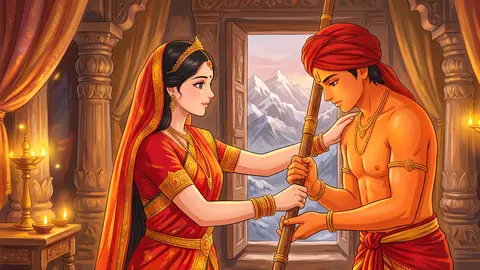
 On a snowy Himalayan ridge, Parvati in a red sari pours water from a gold vessel to wash the feet of Shiva, who sits with eyes closed on a tiger-skin, while two ganas stand silent at the gate.
Scene 2 of 9
I am Prakriti
On the ridge of Gangavatarana, Shiva sat in tapas, his ganas silent at the gates.
Himavan came with fruit, flowers and his daughter. “Let her serve you.”
Shiva looked at her, and shut his eyes. “Come yourself; leave her at home. A young woman stands in an ascetic’s way.”
Parvati bowed. “Your tapas runs on Prakriti’s power, and I am Prakriti. If you are beyond her, why fear me near you?”
“Then serve me, every day,” said Shiva. “But if I am beyond illusion, what then?”
Daily she washed his feet; sometimes she brought kusha and flowers, or sang.
He resolved to accept her once no seed of pride was left: once she had done tapas herself. He saw her, and did not see her.
 The asura Taraka stands on one foot on a bare rocky plateau, arms raised with palms joined under a blazing sun, as a blaze of light rises from his head into the sky.
Scene 3 of 9
Only Shiva’s son
A hundred years on one foot, eyes on the sun. A hundred on one toe. A hundred on air alone, a hundred among fires, a hundred hanging head-down from a branch. A blaze rose from Taraka’s head and scorched the gods’ worlds.
Brahma came; Taraka asked two boons. “Let no man equal my strength. Let me die only when a son of Shiva leads an army against me.”
He took the three worlds. Indra gave up Airavata, Kubera his nine treasures. Even the sun shone softly, so as not to trouble him.
“Only Shiva’s son can kill him,” said Brahma.
Indra called his friend Kama.
“Even Shiva will fall to me,” said Kama. “Five soft flower arrows, a bow of flowers strung with bees.”
 In a grove of flowering mango and ashoka, Shiva sits on a tiger-skin as fire leaps from his third eye toward Kama, who stands at his left with a bow of flowers strung with bees, Rati at his side with her hands on his arm; two gods bow in the distance, and Parvati in red watches from under a tree with a plate of flowers.
Scene 4 of 9
The third eye
Spring broke over Shiva’s grove out of season. Mango and ashoka flowered, cuckoos called, bees droned, and the forest could not bear it.
Kama stood at Shiva’s left with Rati, a mango-blossom arrow ready. He found no way into that mind.
Then Parvati came with flowers. For a moment Shiva came out of meditation, and the arrow flew.
“A face, or the moon? Eyes, or blue lotuses?” He caught himself. “Who has stirred my mind?”
He looked round. Kama, on his left, bow drawn. Kama loosed his unerring arrow; on Shiva it failed, and was stilled. Kama trembled and called the gods. They came, praising Shiva.
Fire leapt from the eye in Shiva’s forehead. Before they could cry “Forgive him!”, Kama was ash.
 Rati kneels weeping on the grass, one hand reaching toward a small heap of grey ash, while Indra and another god stand near her with bowed heads.
Scene 5 of 9
Keep the ash
Rati fell as if dead. Waking, she cried at the gods: “You brought him here to die!” Even the trees grieved.
“Keep some ash,” said the gods. “The Lord will give him back.” And Shiva gave his word: Kama would stay bodiless until Vishnu came as Krishna, then be born Krishna’s son, and Rati would have him again.
Parvati had fled home, white-faced. “Shame on my beauty,” she said, and whispered only, “Shiva, Shiva.”
Narada came. “You served him without tapas. Now do tapas.” He gave her the five-syllabled mantra.
“Do it at home,” her mother begged. “U ma! Oh, don’t!” So she was called Uma.
Mena relented. Parvati put on bark and deerskin and climbed to the ridge where Kama had burned.
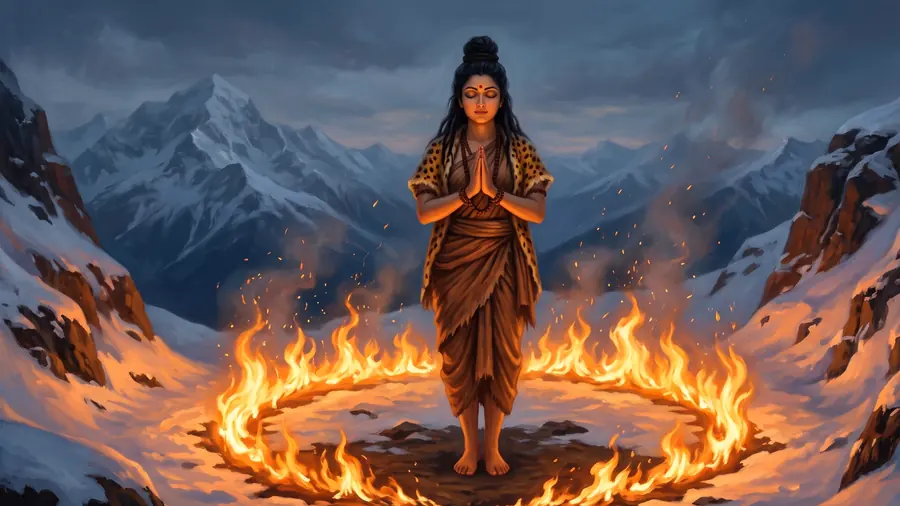
 Parvati, her hair matted, in bark cloth with a spotted skin over her shoulders, stands with joined palms and closed eyes inside an unbroken ring of blazing fire on a snowy Himalayan ridge at dusk.
Scene 6 of 9
Not even a leaf
Summers she stood ringed by blazing fire. In the rains she sat on bare rock under the downpour. Winters she stood in water, fasting through nights of snow. One year she lived on fruit, one on leaves, then not even leaves, and the gods called her Aparna. On one foot, hair matted, she chanted the five syllables. Three thousand years passed. Lion and cow made peace.
Her father came. “Shiva is the moon in the sky. No one catches him.”
She smiled. “My tapas will bring him here.”
The three worlds grew hot. Scorched, the gods went to Brahma, then Vishnu, then Shiva, bowing at her hermitage on the way.
“I have no taste for marriage,” Shiva told the gods. “Yet for you, I will.”
 In a deodar grove Parvati stands unharmed in pale, cool flames, while a very old ascetic with a white beard, a palm-leaf umbrella and a staff looks on, a soft light about him.
Scene 7 of 9
The old ascetic
A brahmachari entered her grove: very old, matted hair, umbrella and staff, a light about him. It was Shiva, come to test her.
“So young,” he said, “and such tapas. Who are you?”
“Himavan’s daughter. Once I was Sati. Shiva burned Kama and left me. Now I enter the fire.” She stepped into the flames. They turned cool as sandal paste.
He laughed. “Shiva? Pyre-ash, serpents, elephant hide, no family. You would give gold for glass.”
“The gods wear on their heads the ash from his body,” she said. “Vijaya, stop him. Let us go.”
She turned. Shiva, in his own form, held her. “Where would you go? I will not leave you again. From today I am your servant, bought by your tapas.”
 In his mountain palace King Himavan, turmeric and saffron on his silver beard, sits with joined palms before the seven sages, as white-robed Vasishtha speaks to him.
Scene 8 of 9
The giver and the beggar
“Go to my father,” Parvati said. “Beg me of him, as alms.”
But Mena had heard Shiva mocked. She lay in the chamber of anger, necklaces flung off. “Give her to him, and I take poison.”
Shiva sent the seven . They came down the sky with Arundhati, who went to Mena. Vasishtha faced the king. “You call him poor? Kubera is his servant.”
Meru and the mountains agreed: she was born for Shiva.
“All I have is Shiva’s,” said Himavan.
“You are the giver,” said the , “Shiva the beggar, Parvati the alms.” Turmeric and saffron were smeared on the mountain’s beard.
On the fourth day they returned to Shiva. He laughed. “I have never seen a wedding. Tell me what is done.”
 At the wedding fire, Himavan lays the hand of Parvati, a bride in red and gold, in the open hand of radiant Shiva, while Narada plays his veena beside them.
Scene 9 of 9
Out of the ashes
From her terrace, with Narada, Mena watched the procession. Vasus, Yakshas, Indra, the moon, the sun, each brighter than the last. “That is Shiva!” “No.” Then Vishnu, four-armed, in yellow garments. “Him, surely!” “No.”
Shiva came on his bull among his ganas, ash on his skin, and Mena fell senseless. Only when he took a form bright as countless suns did she bow.
At the altar Himavan asked his lineage. Shiva turned his face away. Narada played his veena. “Sound alone is his lineage.”
“To the great Rudra,” said Himavan, and laid his daughter’s hand in Shiva’s.
Then Rati brought a knotted bag of ashes. “Make my husband live again.” Shiva looked, and out of the ashes rose Kama, bow in hand, smiling.
You’ve reached the end of this story.
The end
How this story closes
“Sound alone is his lineage.”