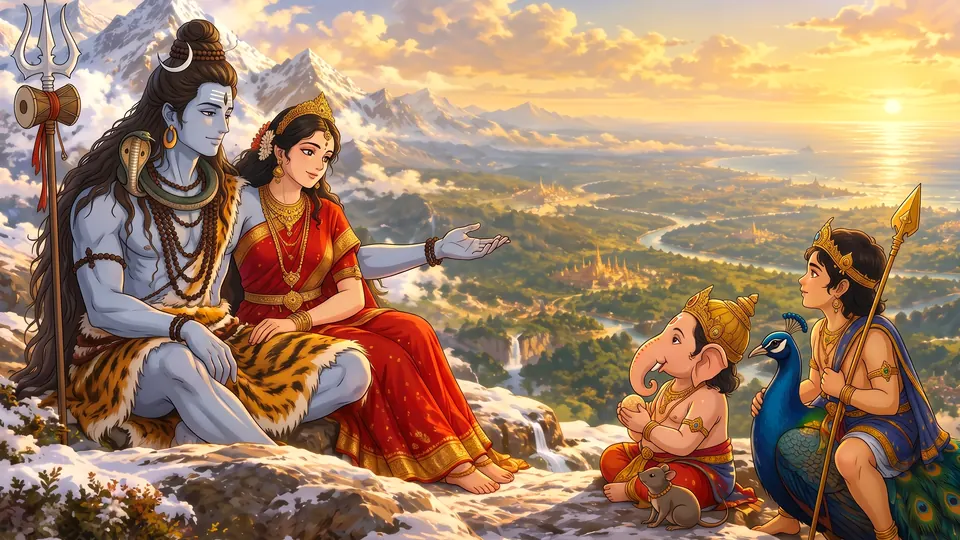
Shiva’s fire is too fierce for Agni, too fierce for Ganga. In a thicket of reeds it becomes a boy, and six mothers quarrel over who will hold him.
Six faces for six mothers. Also known as: Kartikeya birth, Shanmukha.
Tap an underlined word for its meaning.
 At the white stone door of his inner rooms on Kailasa, Shiva stands calm as a weeping, four-armed Vishnu and a white-bearded, crowned Brahma plead with joined hands, the gods behind them, while a small dove lowers its beak to a blaze of golden light on the floor.
Scene 1 of 9
At Shiva’s door
“Lord, what are you doing in there? Save us. Taraka is grinding us down.”
Vishnu stood weeping at the door of Shiva’s inner rooms on , Brahma and the gods behind him. Only a son of Shiva could end Taraka. Shiva had married Parvati, a thousand of the gods’ years had gone by, and there was no son.
Shiva came to the door.
“What must happen, happens,” he said. “Who will take up this fire now? Let him take it.” And he let his own energy fall to the ground.
The gods urged Agni. Agni took a dove’s shape and swallowed all of it.
It burned even the god of fire. “Lord,” he cried, “your radiance is past bearing. Take this burning from me.”
 At dawn on the bank of the Ganga, a newborn boy with a single face glows with soft gold light in a nest of bent shara reeds as flowers fall on him from the sky.
Scene 2 of 9
A thicket of reeds
In the month of Magha the wives of the seven came for their dawn bath, and six of them, shivering, went to warm themselves at Agni’s flame. Arundhati could not stop them.
Shiva’s fire passed from Agni into the six. The six could not hold it either. They laid it on Himavat’s heights. The mountain trembled, scorched, and flung it into the Ganga. Ganga could not bear it. With her own waves she set it down in a thicket of reeds.
In the reeds lay a boy, bright, beautiful. A drum sounded in the sky. Flowers rained on him.
In the south he is Murugan; the Tamil Puranam tells it otherwise: six sparks from Shiva’s eyes. See “The Vel and the mango tree”.
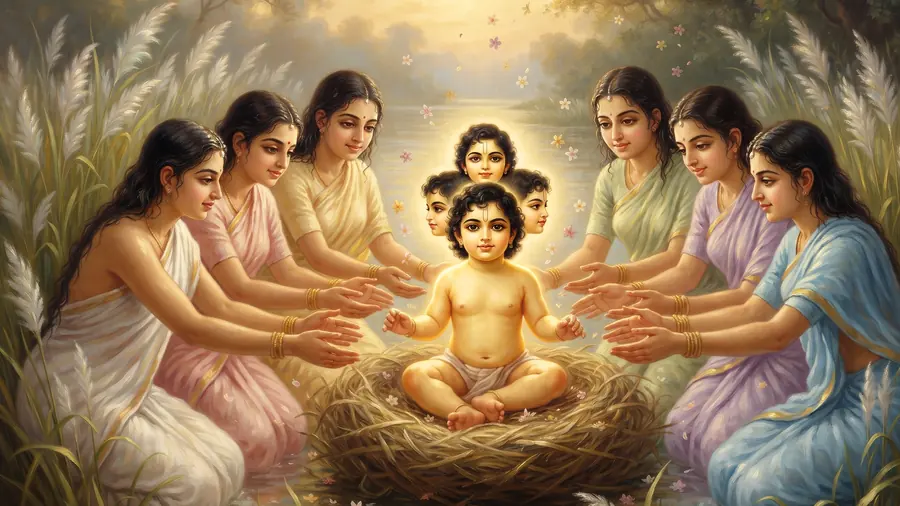
 Six young mothers in six soft colours of sari kneel among the reeds with outstretched hands around a golden baby who sits up in a nest of reeds with a ring of several faces on one neck.
Scene 3 of 9
Six faces
Agni came to the reeds. “My son,” he said, and held the child, kissed him, and put a weapon in his hand: a shakti, a spear.
The boy climbed a peak and struck it. The peak fell. The three worlds shook, and Indra came with his thunderbolt. He struck the child’s right side, his left, his heart. From each blow sprang another warrior: Shakha, Vishakha, Naigama. Four now, they rushed at Indra, and the king of the gods fled home, not knowing the boy’s secret.
Then six women, the Krittikas, came to bathe, and saw him. Each wanted to take him up. They quarrelled.
So the boy made himself six faces and drank the milk of all six.
Content, they carried him home.
 In a pillared hall on Kailasa, Shiva laughs and Parvati looks up at him hopefully, while Agni, Himavan, Ganga, Vayu, Chandra and Dusk stand in a row on the left, ready to answer.
Scene 4 of 9
Where is my son?
“Your fire fell to the ground, not to me,” Parvati said to Shiva. “Where did it go? It cannot have come to nothing. Has it become a child somewhere?”
Shiva laughed, and called the gods, and the witnesses of all deeds. “Who has hidden it?”
One by one they answered.
Fire: “As a dove I took it, and could not bear it.”
The mountain: “Nor could I. I cast it into the Ganga.”
Ganga: “Nor I. Worn out, I left it among the reeds.”
Wind: “There, on the riverbank, it became a beautiful boy.”
The Moon: “The Krittikas took the crying child to Badarika.”
Dusk: “They nurse him now. They have named him Kartikeya.”
Parvati gave away a crore of gems. Shiva sent his ganas.
 At sunset the six-faced boy steps up into an open gold chariot as six Krittikas with loose hair cling to him weeping, Nandin standing calm at his side among Shiva’s attendants.
Scene 5 of 9
The mothers
Virabhadra, Nandishvara, Mahakala, spirits in their hundred thousands: Shiva’s host ringed the Krittikas’ house.
“Child, soldiers on every side!”
“Mothers, put away your fear,” said Kartikeya. “I am a boy, but who can stop me?”
Nandin sat down before him. “Brother, Shiva has sent me. He will crown you among the gods, and you will slay Taraka.”
“These women nursed me. I am their son. And I am no less the son of the mountain’s daughter. I will come.”
Parvati had sent a hundred-wheeled chariot. He climbed in, heart aching. The Krittikas ran to him, hair unbound. “Ocean of mercy, will you leave us? Where shall we go?” They clung to him and fainted.
He roused them with spiritual teaching and took them along.
 Inside Shiva’s hall, the laughing god holds his six-faced son on his knee as the boy plays with the small cobra at his father’s throat and Parvati watches with a hand on her heart.
Scene 6 of 9
Kailasa
Under a banyan on the chariot stopped, Nandin at the boy’s right hand.
Conches and drums. Shiva came out with Vishnu, Brahma and the gods; Virabhadra and the ganas kept time on cymbals. Parvati had set rubies along the road, and came with Lakshmi and the goddesses. Those who looked at the boy saw a halo like molten gold. Vishnu, Indra and Brahma lay flat on the ground before him.
Kumara saw his father and mother, stepped down and bowed.
Shiva held him and kissed his head. Parvati caught him in her arms.
On his father’s knee the boy played with Vasuki, the serpent at Shiva’s throat. Shiva laughed and spoke of it to Parvati; love closed his throat, and he said no more.
 The crowned six-faced boy sits on a gold lion-footed throne, one hand on his knee and the other resting on a golden lion’s head. On the left stand Shiva with one palm raised in blessing, Parvati, Varuna holding a white ceremonial parasol over the boy, and Agni with the great spear; on the right stand Vishnu, Brahma with his hands folded, and Indra holding his vajra, with gem-set water pots at the foot of the throne.
Scene 7 of 9
We march today
Shiva seated him on a jewelled throne and bathed him from hundreds of jewelled pots, with water from every sacred ford.
Vishnu: a crown, his garland Vaijayanti, a discus. Shiva: the trident, the bow Pinaka, an axe. Brahma: the sacred thread and the Vedas. Indra: an elephant, a thunderbolt. Varuna: a white umbrella. The Sun: a chariot swift as thought. Agni, to his son: a great shakti, the spear.
Parvati, smiling, gave him sovereignty and long life. Tamil tradition, not the Shiva , has her give him the Vel; Thai Pusam honours the victory it won. See “The Vel and the mango tree”.
“Taraka will die by Kumara’s hand,” said the gods. “For that he was born. We march today.”
Shiva gave them his son.
 On a grey shore where the river meets the sea, the six-faced boy stands with a shining spear beside his empty chariot, Taraka faces him with a scornful open hand, and Indra on his white elephant and Vishnu look on.
Scene 8 of 9
“This child?”
Where the Mahi meets the sea, Taraka came with drums like doomsday clouds. Here he is the asuras’ king; in the Tamil Puranam, Surapadman’s brother.
His spear struck Indra senseless from his elephant. He took ten thousand arms and rode a lion through the gods. Vishnu’s mace he split with his trident.
“Only you can kill him,” Brahma told Kumara. “My boon bars all others.”
Kumara laughed. “So be it.” He stepped down from his sky-chariot, spear in hand.
“This child will kill your enemies?” said Taraka. “Let him go and live.”
Indra’s thunderbolt threw him down; he rose and felled Indra. Vishnu’s discus: he rose and felled Vishnu. Virabhadra’s trident: he rose and felled Virabhadra.
Virabhadra stood again, trident blazing. Kumara stopped him.
 Under huge close mountains and a dim red sun, the six-faced boy lifts his shining spear the instant before he strikes, facing Taraka, who levels his own spear at him.
Scene 9 of 9
The spear
They fought on foot, spear against spear, like two lions, and no watcher could say who would win.
A voice from the sky: “Kumara will kill Taraka. Shiva himself stands here, as his son.”
Taraka’s spear struck Kumara senseless. He rose, furious, and struck back. The wind stopped. The sun dimmed. The earth shook, and Himalaya and the mountains came, afraid for the boy.
“Mountains, do not grieve,” said Kumara. “I will end him.”
He bowed to Shiva and Parvati, lifted the spear, and struck.
Taraka, lord of the asuras, fell to earth and died. Kumara struck no second blow.
Shiva came with Parvati and took his son, bright as the sun, onto his lap; she caressed him. Flowers fell. Gandharvas sang. “Victory!” rang out.
You’ve reached the end of this story.
The end
How this story closes
Shiva came with Parvati and took his son, bright as the sun, onto his lap; she caressed him.