A newborn sees the rising sun, takes it for a fruit, and leaps. Years later, on a hopeless shore, old Jambavan reminds him who he is.
Hanuman and the sun. Also known as: Bal Hanuman and Surya, Birth of Hanuman.
Tap an underlined word for its meaning.
 On a rocky shore above the endless sea, old Jambavan the bear speaks with a raised paw beside young Angada among the vanara chiefs, while Hanuman sits alone on a rock to the right, his mace beside him.
Scene 1 of 9
Ten, twenty, ninety
A hundred yojanas of ocean lay before them. At Angada’s word, each chief said how far he could leap.
Gaja, ten yojanas. Gavaksha, twenty. Gavaya, thirty. Sharabha, forty. Gandhamadana, fifty. Mainda, sixty. Dvivida, seventy. Sushena, eighty.
Then Jambavan, eldest of them all. “Ninety. Once it was more: at Bali’s sacrifice I walked around Vishnu as he took his three strides. Now I am old. Ninety is not enough.”
“I can go the hundred,” said Angada. “Whether I can come back, I cannot say.”
“A master sends; he is not sent,” said Jambavan.
“Then, if no one goes, we fast to death again.”
“This will not fail,” said Jambavan. “I will rouse the one who can do it.”
Apart from them all, alone, sat Hanuman.
 On the shore, Jambavan leans on his staff and reaches toward the seated Hanuman, while above them, in a glowing vision among the clouds, Anjana in yellow silk and a flower garland stands startled beside the pale, silver-skinned Wind.
Scene 2 of 9
Why so silent?
Jambavan saw the army, hundreds of thousands, in despair, and turned to Hanuman.
“Why sit alone and silent, you who know every shastra? In strength and fire you equal Sugriva, Rama and Lakshmana. Why do you not know yourself?”
Then he told Hanuman who he was.
His mother Anjana, Kesari’s wife, was once Punjikasthala, finest of apsaras, cursed to be born a vanari. In human form, garlanded, in yellow silk, she stood on a mountaintop. The Wind saw her, loved her, and took her in his long arms.
“Who would break my vow to my husband?” she cried.
“I am not hurting you,” said the Wind. “I came to you in mind alone. You will have a son, mighty and wise, my equal in leaping.”
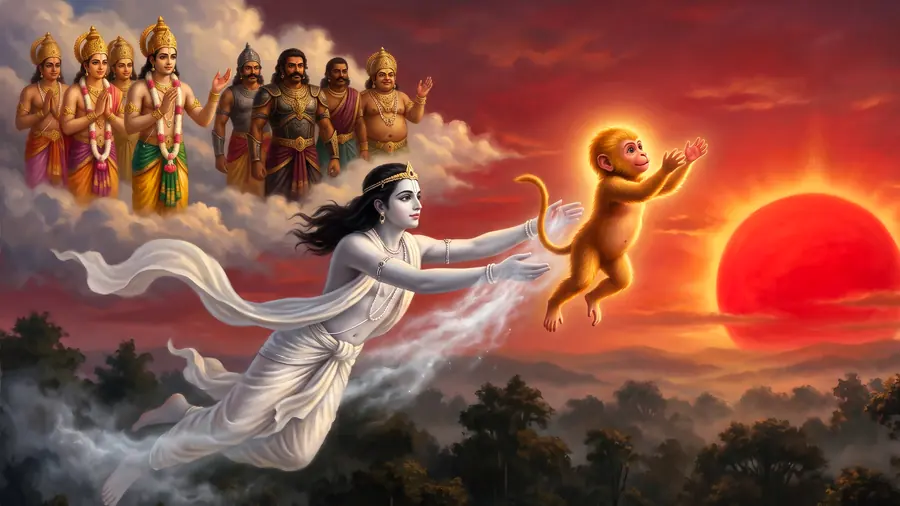
 Above a misty forest at dawn, the glowing newborn Hanuman leaps toward a huge hibiscus-red sun as the Wind flies after him with outstretched arms, while gods, asuras and yakshas watch in wonder from the clouds.
Scene 3 of 9
A fruit in the sky
A newborn lay crying in the forest, alone and hungry. His mother had gone to gather fruit.
So the Agastya would tell it to Rama, after the war, in Hanuman’s presence.
Then the child saw the sun rising, red as a heap of hibiscus. A fruit! He sprang into the sky, a small sun leaping at the young sun.
Gods, danavas and yakshas marvelled. “Not the Wind, not Garuda, not even thought is this fast!”
His father the Wind flew after him, cool as snow, so the sun would not burn him. Thousands of yojanas the child climbed, and came near the sun.
The Sun did not burn him. A child, he thought, who knows no wrong; and a great work waits on him.
 Crowned Indra, the vajra in his raised hand, rides the four-tusked white elephant Airavata through golden clouds, while ahead the great crowned head of Rahu rushes toward the red sun, where the tiny newborn Hanuman, a glowing golden baby monkey, reaches out with both arms.
Scene 4 of 9
Another Rahu
That same day, says Agastya, Rahu came to seize the sun.
On the sun’s own chariot the child touched him. Rahu, crusher of sun and moon, drew back in fright, and went straight to Indra’s hall, frowning with rage.
“Slayer of Bala and Vritra! You gave me the sun and moon to ease my hunger. Why give them to another? I came at the hour of the eclipse, and another Rahu had already seized the sun!”
Indra sprang up from his seat, his golden garland still about him. He mounted Airavata, king of elephants, tall as a peak of , four-tusked, golden bells ringing.
Rahu went ahead. Behind him the king of the gods rode out, to where the sun and the child were.
 High beside the red sun, the blazing newborn Hanuman reaches for the white elephant Airavata as Indra, his hand now open, has loosed the golden vajra toward him, and the crowned head of Rahu cries out above.
Scene 5 of 9
A bigger fruit
Rahu raced on, leaving Indra behind. The child saw him rushing in like a mountain peak. Another fruit! He let go of the sun and sprang.
Rahu, who is nothing but a head, wheeled and fled. “Indra! Indra!”
“Do not fear,” said Indra. “I will kill him.”
Then the child saw Airavata. A bigger fruit! He ran at the king of elephants, and for a moment his form blazed, terrible as Indra and Agni.
Indra, not greatly angry, loosed the thunderbolt from his hand. The child fell onto a mountain; as he fell, his left jaw broke.
Jambavan tells it another way: three hundred yojanas up, the sun’s blaze flung the boy back; he did not lose heart; and Indra, in anger, hurled the thunderbolt.
 In a still, windless world, a crowd of gods, asuras and ordinary people stands breathless before four-faced Brahma on a great pink lotus, while far off in a cave the Wind sits holding his glowing child.
Scene 6 of 9
When the Wind stopped
The Wind saw his son fall, and his anger turned on Indra. In Agastya’s telling, he drew himself in, took the child, and went into a cave.
Breath stopped. Every creature stood stiff as wood. No Veda was chanted, no offering made. The three worlds were like a hell.
Gods, gandharvas, asuras and men ran to Brahma, bellies swollen with breath that could not move. “You gave us the Wind as lord of our lives. Why has he shut us in?”
“Indra struck down his son today, on Rahu’s word,” said Brahma. “The Wind moves in every body, having none of his own. Without him a body is only wood. Come. We must go to him and win him back, or perish.”
 In a dim cave lit by the child’s golden glow, the tearful Wind holds up his newborn son as four-faced Brahma lays a hand on him, and Indra stands near holding a garland of pink and white lotuses.
Scene 7 of 9
Brahma’s touch
In the cave, the child lay in his father’s lap, shining like the sun, like fire, like gold. Brahma looked, and was moved to pity.
The Wind, stricken by his son’s death, rose with the child and fell at Brahma’s feet. Brahma raised him and stroked the child. At that touch, like a crop given water, the child lived again.
And the Wind moved once more through every creature. The worlds breathed, glad as lotus pools freed from frost and heat.
“This child will do your work one day,” Brahma told the gods. “Give him boons, to please the Wind.”
Indra lifted a garland of lotuses. “My thunderbolt struck his hanu, his jaw. Let him be called Hanuman. My thunderbolt will never kill him.”
 In a forest hermitage of thatched huts, the boy Hanuman, a small golden-furred vanara in a red waist-cloth with a sage’s bark cloth slung over his shoulder, grins as he brandishes a wooden ladle and a snapped-off piece of another, with a broken pot, dropped bark cloths and a fallen ladle on the ground, while four sages turn toward him beside the smoking brick fire altar and the white-bearded sage in front raises his hand to speak.
Scene 8 of 9
Gifts, and a curse
“A hundredth of my radiance,” said the Sun. “When he can study, I will teach him. None will match him in the shastras.” Varuna, Yama, Kubera, Shiva and Vishvakarma swore their weapons would never kill him.
“He will be unconquerable,” Brahma told the Wind. “For Ravana’s end and Rama’s joy, he will do deeds that make hair stand on end.”
Jambavan names two: Brahma’s, that no weapon would kill him in battle; Indra’s, death only when he chose.
Full of strength, Agastya says, the boy ran riot in the ’ hermitages, breaking ladles, scattering bark cloths. The sages cursed him. “You trouble us, trusting your strength. You will not know it for a long time. When someone reminds you of your glory, it will grow.”
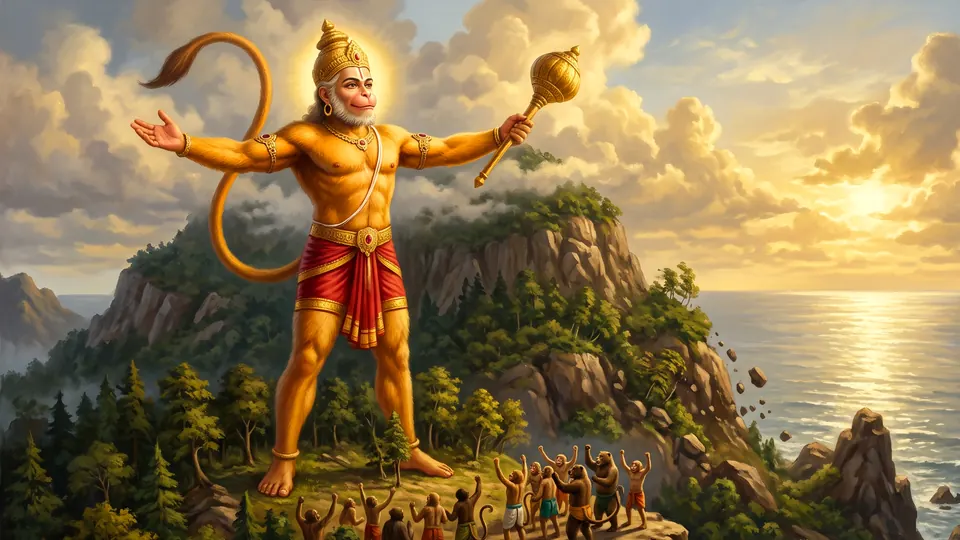 Grown colossal on Mount Mahendra, Hanuman stretches out his arms with his mace raised and his face haloed in light, as rocks tumble from the shaking mountain and the vanaras below cheer him on.
Scene 9 of 9
Rise!
On the shore, old Jambavan was doing just that.
“You are Kesari’s son and the Wind’s own, his equal in leaping. Our life-breath is all but gone. Rise, tiger among ! Cross the great ocean!”
And Hanuman grew.
The forgot their grief and roared his praise. Lashing his tail for joy, he stretched like a lion in a mountain cave; his face blazed like smokeless fire.
“I could chase the blazing sun from its rising,” he said, “reach it before it sets, and come back without touching the ground. I will see Sita! Rejoice, !”
He climbed Mahendra. Under his feet the great mountain was like an elephant a lion has struck, and it shook.
In his mind, he was already in Lanka.
You’ve reached the end of this story.
The end
How this story closes
In his mind, he was already in Lanka.