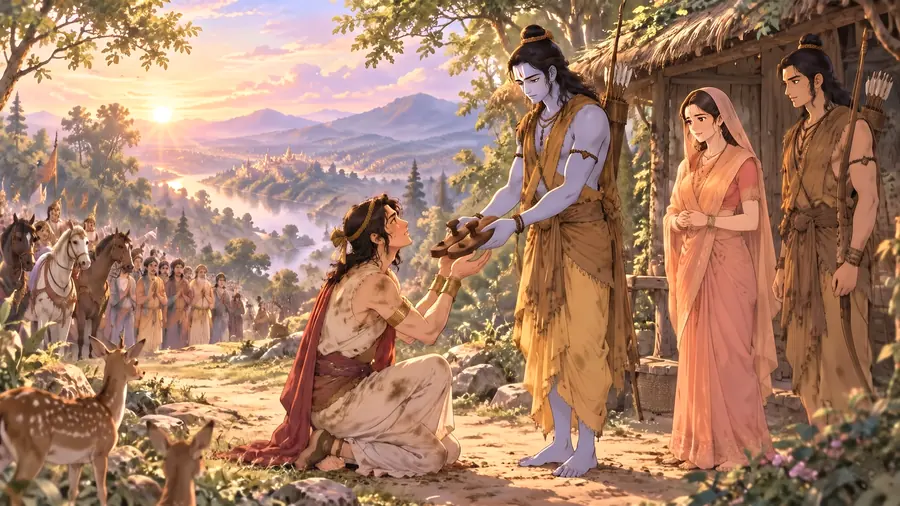
On the eve of his crowning, Rama is sent to the forest. Sita and Lakshmana follow, Guha keeps watch by the Ganga, and Bharata climbs to Chitrakuta to give back a throne he never wanted.
Ram Vanvas. Also known as: Rama’s exile, Bharat Milap.
Tap an underlined word for its meaning.
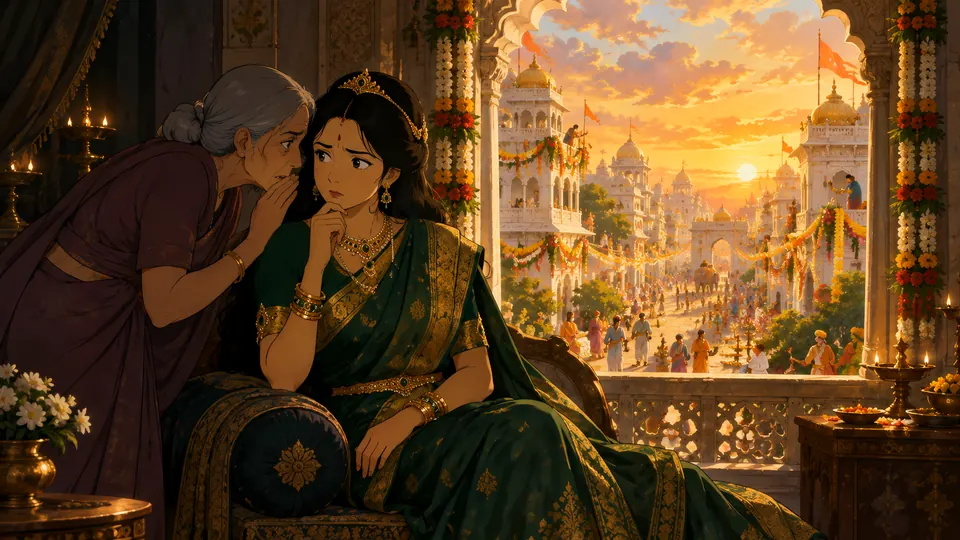 In a dim palace chamber, the grey-haired maidservant Manthara leans close to whisper to Queen Kaikeyi in a green-and-gold sari, while through the archway behind them Ayodhya’s streets are hung with garlands for a celebration at sunset.
Scene 1 of 10
Flags over Ayodhya
is hanging out its flags. Dasharatha has grown old, and he has decided: Rama will be consecrated as heir. The assembly roared its welcome. Now the streets are swept, the gateways garlanded, and the whole city leans towards morning.
Two princes are missing from the joy. Bharata and Shatrughna are far away in Kekaya, at their mother’s family home.
From a high terrace the maidservant Manthara has seen the decorations. She comes to Queen Kaikeyi and bends close. Once Rama is crowned, she whispers, Bharata will be pushed aside. He may even be sent out of the kingdom.
The words take root. Long ago the king promised Kaikeyi two boons. She resolves to claim them now. Outside, the lamps of celebration are being lit.
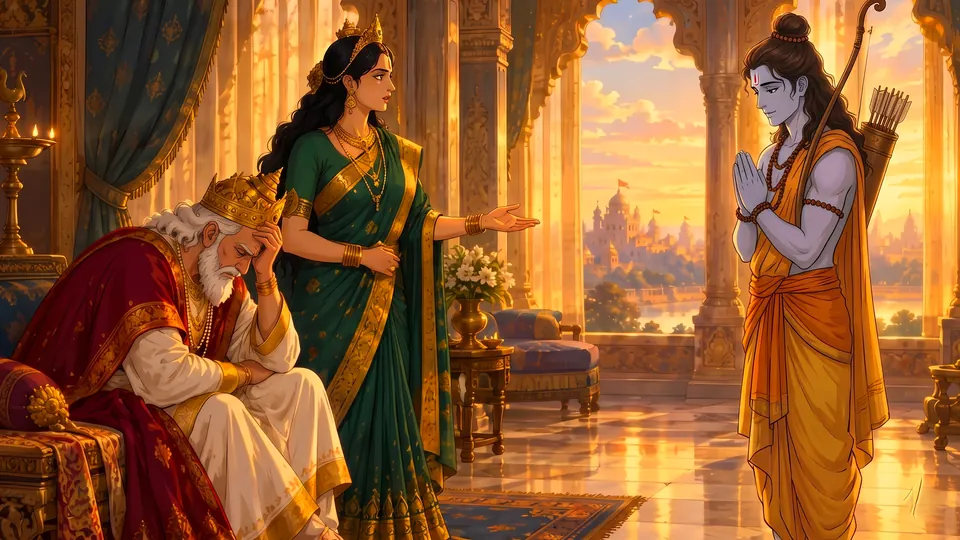 In Kaikeyi’s palace chamber, the white-bearded King Dasharatha sits slumped with his hand to his brow while Queen Kaikeyi stands beside him explaining, and the blue-skinned Rama, bow and quiver on his back, faces them with palms joined in quiet acceptance.
Scene 2 of 10
Two boons
All night the king begs Kaikeyi to relent. She will not. She holds him to his word.
At dawn Rama is summoned. He bows at his father’s feet. The king can say one word only, “Rama,” and then his eyes fill and he cannot look at his son.
Rama turns to Kaikeyi. “If my father tells me, I will leap even into fire.”
Then she speaks. Long ago, in a war between gods and demons, the king granted her two boons. Bharata will be installed with the preparations made for Rama. Rama will live fourteen years in the Dandaka forest, hair matted, clothed in deerskin.
Rama does not flinch. He will go, today.
But Kausalya has yet to hear. Lakshmana is burning with anger.
 On a palace balcony overlooking Ayodhya at sunset, Sita, jasmine in her braid, clasps her hands to her heart and looks up pleadingly at Rama, a red-and-white tilak on his brow and his long wavy hair in a top-knot, who gazes down at her tenderly.
Scene 3 of 10
Sita will not stay
Rama asks Sita to remain in and serve the elders. The forest, he warns, is no place for her.
She answers in a rush, half love, half wounded pride. “With you, the forest is heaven. Without you, it is hell.” Thorns and grass will feel like cotton to her, she says; wind-blown dust like sandal powder. If he leaves her behind, she will drink poison.
Rama yields. “You were made to dwell in the forest with me. Give gifts to the Brahmanas. Be very quick. Do not delay.” Ornaments, fine clothes, couches and carriages go out to Brahmanas and dependents.
Then Lakshmana, too, refuses to be left behind. One man was sent; three will go.
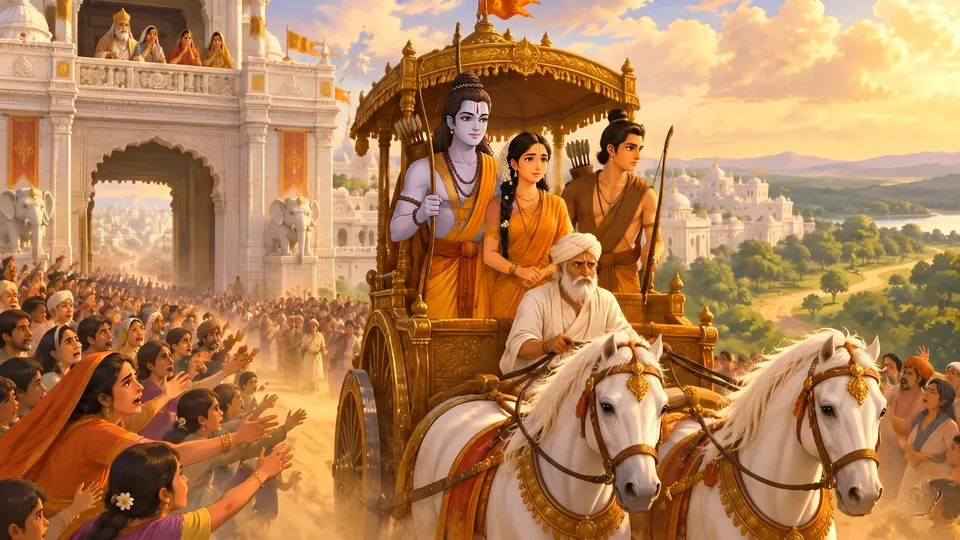 The white-bearded charioteer Sumantra drives a golden chariot drawn by two white horses out of Ayodhya’s gate carrying Rama, Sita and Lakshmana, as weeping townspeople reach after them and the aged king and queens watch from a balcony above.
Scene 4 of 10
The chariot leaves
Sumantra brings the chariot, blazing like the sun. Sita climbs in, then the brothers, and the horses leap forward with the speed of wind.
All runs after them, young and old, like the thirsty running to water. “Slowly, charioteer! Hold the reins. Let us see his face.” The dust from the wheels is laid by their tears.
From behind comes the old king’s cry: “Stop!” From the chariot, Rama: “Go on.” Sumantra is caught between two whirlpools.
The fourteen years have begun. And far away in Kekaya, the prince in whose name all this was done has not yet heard a word.
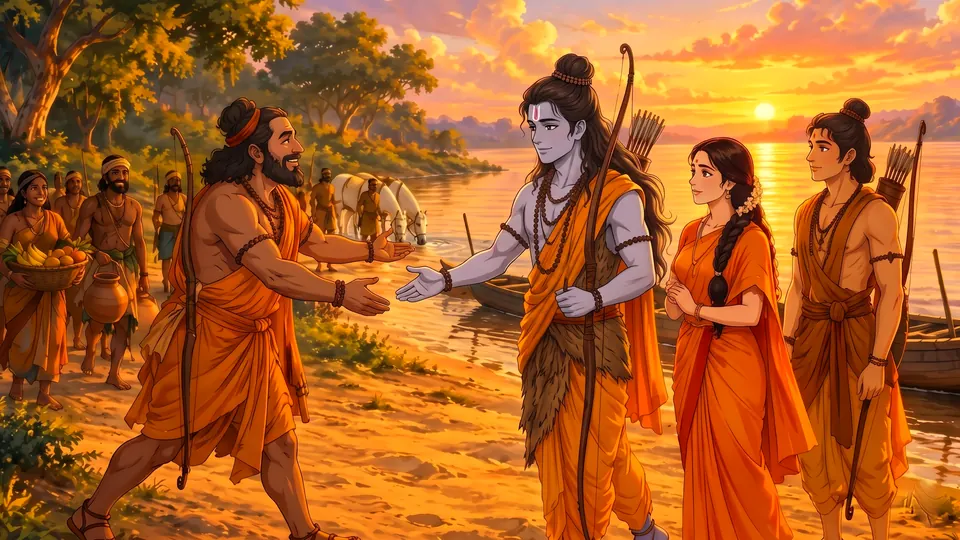 On the sandy bank of the Ganga at sunset, the bearded Nishada chief Guha strides forward with open arms to welcome Rama, as Sita and Lakshmana look on and Guha’s people bring fruit and water and lead horses to drink at the river.
Scene 5 of 10
Guha comes running
Evening on the Ganga. The chariot halts beneath a great ingudi tree, and Sumantra unyokes the horses.
Word has raced ahead to Guha, chief of the Nishadas and Rama’s friend: Rama has come, dressed for the forest. Guha does not wait to be summoned. He comes on foot, his elder ministers and kinsmen behind him, and takes Rama into his arms.
“This city is as much yours as . Where would I find a guest as dear as you?”
His people bring everything: rice and many dishes, water for washing, cool drinks, good beds, forage for the horses. “All this land is yours,” Guha says. “We are your servants. Be our lord.”
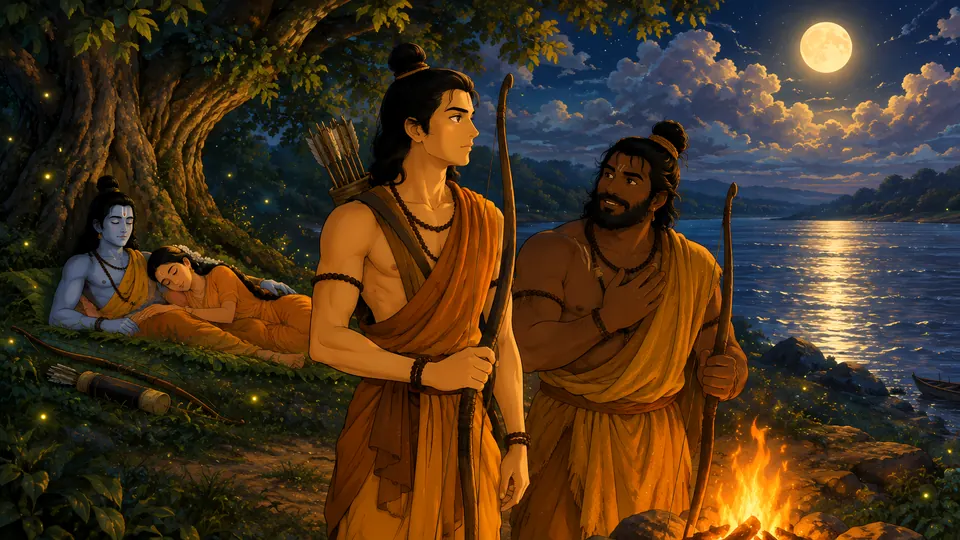 On a moonlit night beside the Ganga, Lakshmana stands watch holding his bow while Guha, hand on his heart, keeps him company by a small fire, and behind them Rama and Sita rest beneath a great tree.
Scene 6 of 10
Night beside the river
Rama receives the love and gently sets the feast aside. “I have taken a vow. I wear bark and deerskin; I live on roots and fruit.” He asks for one thing only: forage for the horses his father cherished.
Guha does not press him. He gives the order, and the horses are fed.
At twilight Rama takes only water, which Lakshmana brings. Then the prince who has never known hardship lies down on the bare ground beside Sita.
Lakshmana washes his brother’s feet and stands by a tree, keeping watch. Guha stays beside him, bow in hand, alert over Rama all night. The long night passes over the watchers.
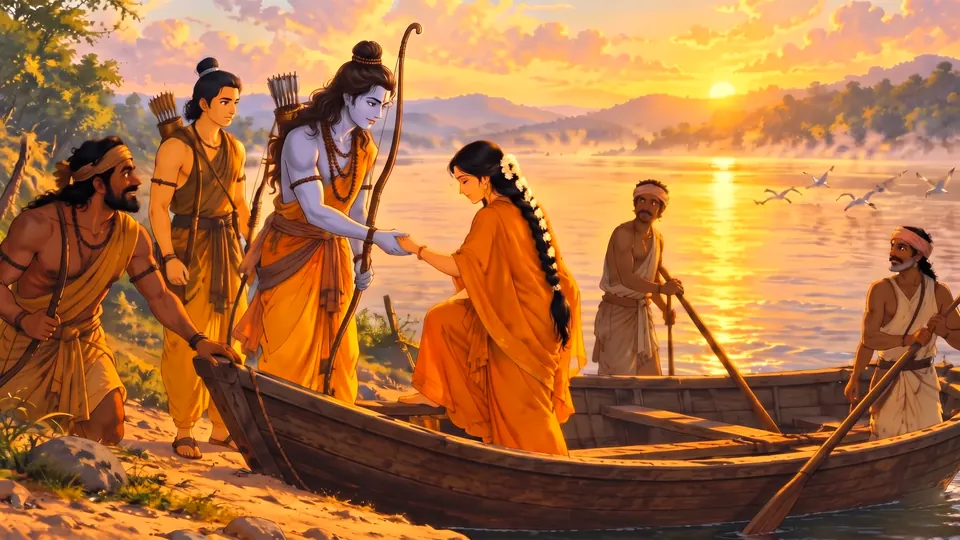 At sunrise on the Ganga, Rama takes Sita’s hand as she steps into a wooden boat held by Nishada boatmen, while Lakshmana waits behind and Guha steadies the boat’s prow from the bank.
Scene 7 of 10
The boat at dawn
Morning rises over the Ganga. Guha’s boatmen hold a wooden boat steady at the water’s edge.
“Lakshmana,” Rama says, “get in, and help Sita aboard.” Lakshmana does not question it. He helps her in, then steps in himself. Rama boards last.
Water. Food. A guarded sleep. Fed horses. And now a boat, held steady against the current.
Guha gives the word, and his kinsmen take up the oars. In midstream Sita joins her palms and prays to the Ganga to bring them home safe. On the far bank the three step ashore. There, the forest begins.
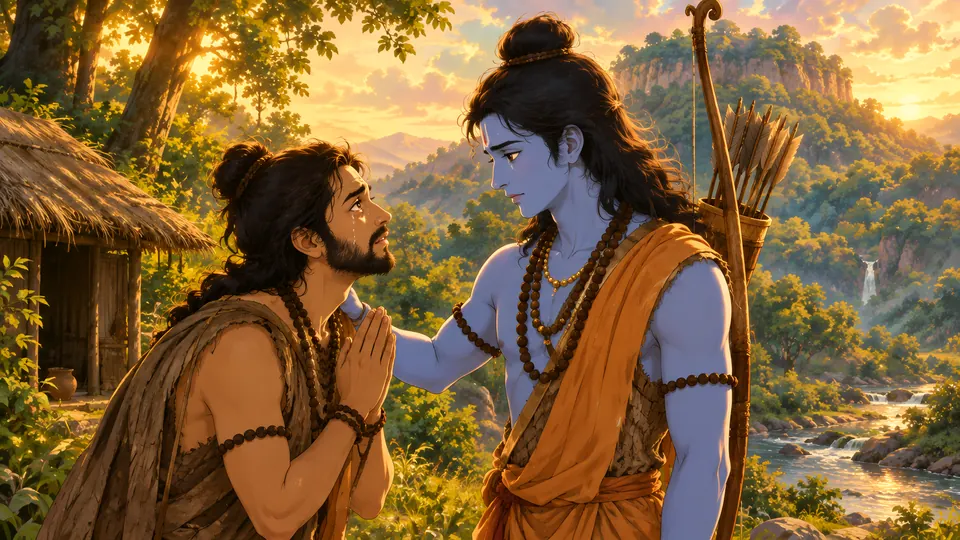 Outside a thatched hut on the hills of Chitrakuta, the bearded Bharata in bark clothing joins his palms and looks up tearfully at the blue-skinned Rama, who rests a hand on his shoulder with a gentle but steady face.
Scene 8 of 10
Come home
Chitrakuta. A thatched hut on the hills, and before it Rama, clothed in bark.
Bharata has come all the way from . He never asked for the throne his mother claimed for him. He has come to give it back.
The , who have heard the brothers argue, now speak: if Bharata honours his father, Rama’s word must be accepted.
Bharata joins his palms and pleads again. His limbs tremble; his voice chokes. “I cannot rule this vast kingdom alone. Come home.” He falls at his brother’s feet.
Rama lifts him onto his lap. Their father gave his word; the years of stand. “Take counsel with your ministers and companions. Rule.”
Neither brother will yield. Bharata has one thing left to ask.
 Outside a forest hut, Rama places his wooden sandals in the hands of the kneeling Bharata, as Sita and Lakshmana look on.
Scene 9 of 10
The golden sandals
“Then set your feet on these,” Bharata says, holding out a pair of wooden sandals adorned with gold. “They will bring gain and safety to all the people.”
Rama steps onto them, steps off, and lays them in his brother’s hands.
Bharata bows before the sandals and names his terms. “For fourteen years I will wear matted hair and bark and live on fruit and roots, outside the city. The kingdom I will offer to your sandals. And if I do not see you the day after the fourteenth year ends, I will enter the fire.”
“So be it,” says Rama, and embraces him. “Protect our mother Kaikeyi. Do not be angry with her.”
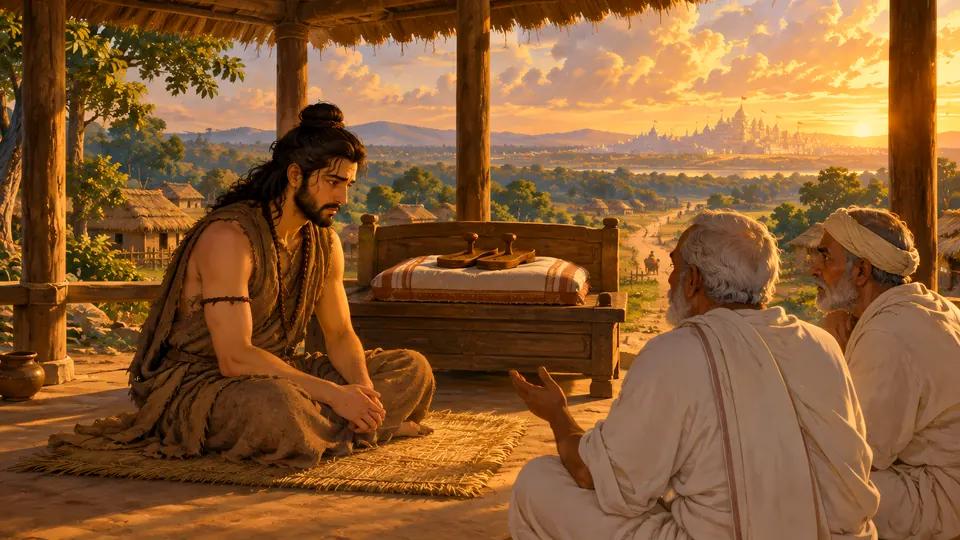 In a simple thatched pavilion at Nandigrama, the bearded Bharata in bark clothing sits on a grass mat beside a plain wooden throne bearing Rama’s sandals, gravely listening to two elderly villagers, with Ayodhya glowing on the far horizon.
Scene 10 of 10
A throne at Nandigrama
Bharata sets the sandals on the head of a great elephant. Behind him, Rama turns back into his hermitage, weeping.
Bharata rides home with only the sandals. He walks through his father’s empty house and brings the queens back to . Then he leaves the city. At Nandigrama, he says, he will wait for Rama.
There the sandals are crowned upon the throne. Bharata himself holds the royal canopy and the chowrie over them. In bark, hair matted, he rules with his ministers.
Whatever business comes before him, he first lays it before the sandals. Every order goes out in a brother’s name.
Fourteen years. If Rama has not come the day after they end, Bharata has sworn to enter the fire.
You’ve reached the end of this story.
The end
How this story closes
Every order goes out in a brother’s name.