A merchant promises a vow if he is given a child, then forgets it. Prison follows, then a cargo turned to leaves, then a boat that sinks within reach of home.
Satyanarayan Katha. Also known as: Satyanarayan Vrat Katha, Story of Sadhu the merchant.
Tap an underlined word for its meaning.
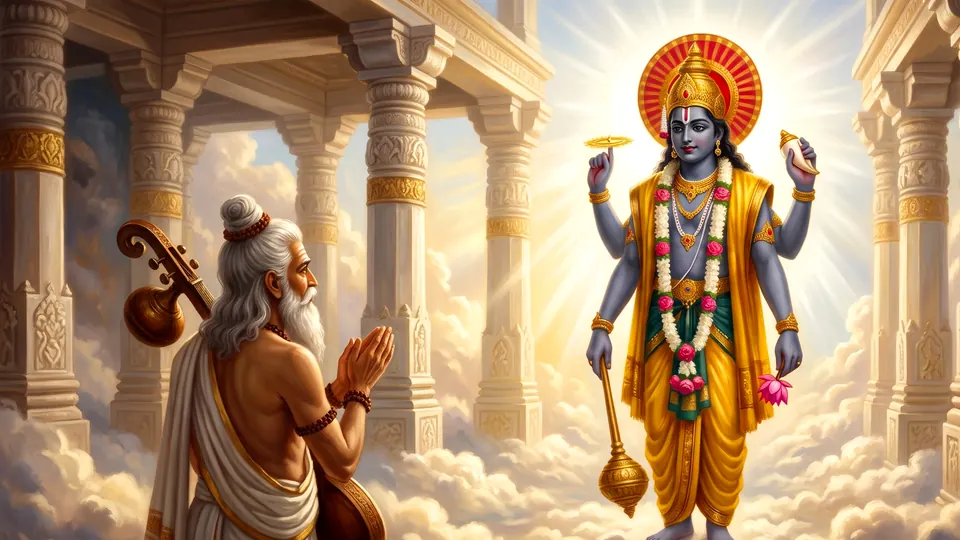 Narada, a white-bearded sage with a veena on his shoulder, stands with joined palms before the four-armed, slate-blue Vishnu, who blazes with white light and holds discus, conch, mace and lotus in a pillared pavilion above the clouds.
Scene 1 of 9
Narada among mortals
In the Naimisha forest, Shaunaka and the asked Suta: what vow or penance wins the heart’s wish? Suta retold the Lord’s answer to Narada. The katha names the Reva Khanda of the Skanda as its home, though not every edition carries it.
Roaming the worlds to help others, Narada came among mortals. Everywhere they suffered, worn down by their own deeds. He went to Vishnu: shining white, four-armed, with conch, discus, mace and lotus.
“Lord, is there a simple way to end their suffering?”
“There is a vow rare in heaven and on earth. On any day, at nightfall, with brahmanas and kin, worship Satyanarayana. Offer bananas, ghee, milk and wheat flour, a quarter over the measure. Hear the katha. Eat the prasad.”
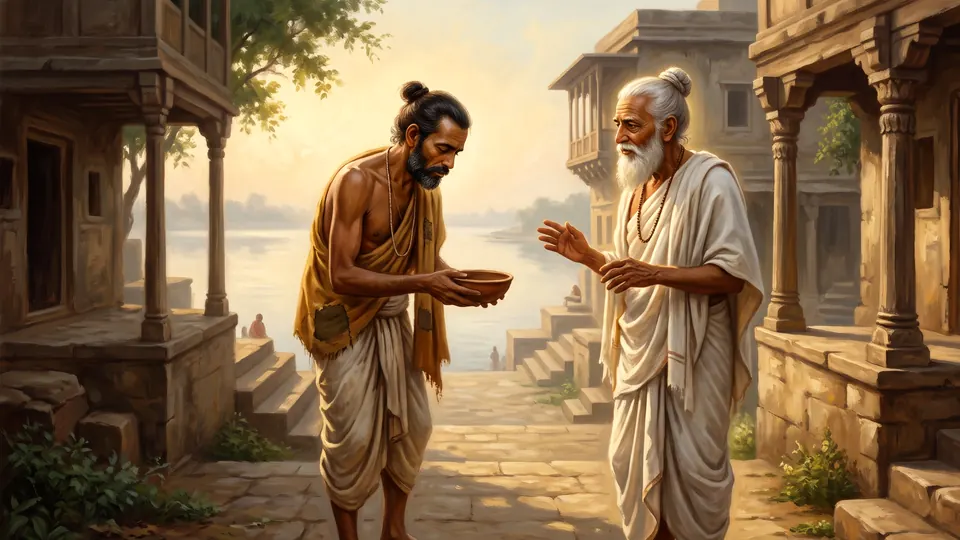 On a riverside lane in Kashi, the gaunt brahmana Shatananda bows over his empty clay begging bowl as a white-bearded old brahmana speaks to him gently.
Scene 2 of 9
Firewood at the door
In Kashi, the poor brahmana Shatananda begged daily, sick with hunger and thirst. An old brahmana asked courteously, “Why do you roam so unhappy?”
“I am poor. If you know a way, tell me.”
The old man, Satyanarayana himself, taught him the vow and vanished. Next day the alms poured in. Shatananda kept it with his kin, and every month after.
One day, as he began, a thirsty woodseller left his load outside and came in. “What does this vow bring?”
“Every wish. All I have is by his grace.”
The woodseller drank, ate the prasad, and sold his wood where the rich lived. It fetched double. He kept the vow. Wealth came, and sons.
Then Suta told of a king, and a merchant’s promise.
 On a river bank at sunset, King Ulkamukha and his queen sit with joined palms at the vow under a cloth canopy, while the merchant Sadhu, his laden boat moored behind him, comes up to greet them.
Scene 3 of 9
A promise on the river
On the bank of the river Bhadrashila, King Ulkamukha was keeping the vow with his lotus-faced queen. Wise and truthful, he gave the brahmanas wealth every day. A merchant named Sadhu, out trading with great wealth, moored his boat there and came up.
“King, what is this worship?”
“Of Vishnu, with my kin, for sons.”
“I have no child either. Teach me, and I will do it.”
Home again, Sadhu told his wife Lilavati, “I will keep the vow when we have a child.”
By the Lord’s grace, in the tenth month, a daughter was born, growing day by day like the waxing moon. They named her Kalavati.
“Why have you not kept the vow you promised?” Lilavati asked gently.
“At her wedding, my love.”
 In a port city street, a hooded thief looks round in fear as he sets down a rope-bound wooden casket spilling gold chains, three of the king’s guards running after him with spears and a sword, while the two merchants sit talking on a veranda nearby, unaware.
Scene 4 of 9
Two thieves
Kalavati grew up. Sadhu’s messenger went to the city of Kanchana and brought back a merchant’s son, handsome and good. Sadhu gave him his daughter with every . As fate would have it, at the wedding he forgot the vow. The Lord was angered.
In time Sadhu went with his son-in-law to trade at Ratnasarapura by the sea, King Chandraketu’s city. There Satyanarayana saw the man who had broken his word, and cursed him: “Hard, terrible sorrow will be his.”
One day a thief stole the king’s treasure. Seeing guards racing after him, he left it where the two merchants were and slipped away.
The guards bound them both. “My lord, we have brought two thieves!”
Without inquiry, both were chained in a great fort.
 At night under a thatched veranda lit by small lamps, Kalavati in a faded rose sari eats prasad from a leaf, while an old brahmana and two women sit beyond the vow’s brass pot and bananas.
Scene 5 of 9
Prasad in the dark
By the Lord’s maya, no one heard a word they said. King Chandraketu took their wealth too.
At home, a thief carried off everything. Lilavati, sick in body and mind, hungry and thirsty, went from door to door for food. Kalavati wandered too.
One day, hungry, Kalavati came to a brahmana’s house where the vow was being kept. She sat, heard the katha, prayed for a boon, ate the prasad, and went home at night.
“Daughter, where were you tonight? What is on your mind?”
“Mother, in a brahmana’s house I saw a vow that grants wishes.”
Lilavati kept it with her kin. “Let my husband and son-in-law come home soon. Forgive them their offence.”
Pleased, the Lord came to King Chandraketu in a dream.
 On a sandy shore, a shaven ascetic in ochre, leaning on a bamboo staff with a water-pot in his hand, faces the merchant Sadhu and his son-in-law, who laugh at him as Sadhu waves a hand toward their boat laden with sacks and chests behind them.
Scene 6 of 9
Creepers and leaves
“King, free the two merchants at dawn. Give back all you took. Or I will destroy you, with your kingdom, your wealth and your sons.”
At dawn the merchants were brought in, freed of their fetters, too frightened to speak. “Fate brought you great sorrow,” said Chandraketu. “Now there is nothing to fear.” He gave them clothes and ornaments, returned their wealth twice over and sent them home.
Sadhu gave gifts to the brahmanas and set out. A little way along, an ascetic with a staff asked, “Sadhu, what is in your boat?”
The two merchants, swollen with pride, laughed at him. “Why ask, ascetic? After our coins? There is nothing aboard but creepers and leaves.”
“Then let your words be true.”
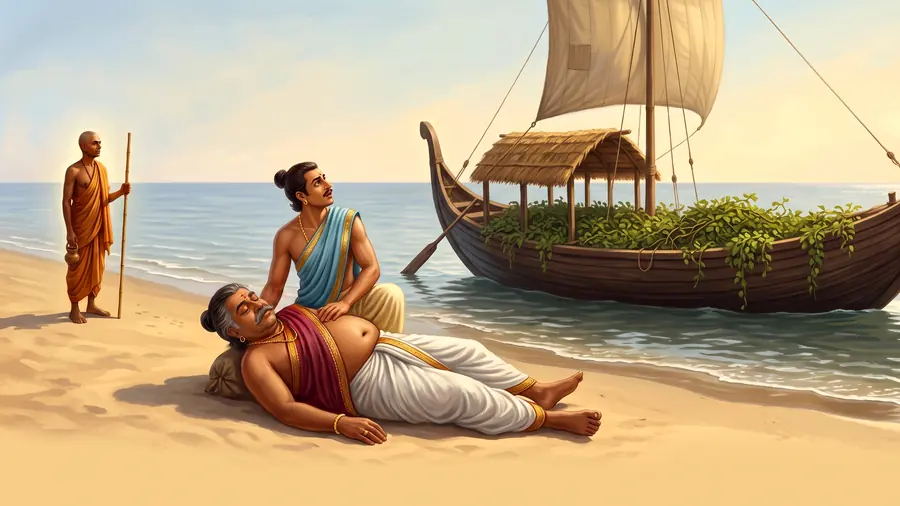
 Sadhu lies senseless on the sand with his eyes closed, his head on a sack, while his son-in-law kneels beside him with a hand on his belly, looking up over his shoulder in alarm; behind them their boat rides high, heaped with green creepers and leaves, and a little way off on the shore the ascetic stands watching with his staff and water-pot.
Scene 7 of 9
The boat rides high
The ascetic walked away and stood by the sea. Sadhu finished his daily rites, and stared. His boat was riding high. Inside lay creepers and leaves. He fell senseless.
“That ascetic can do anything,” said his son-in-law. “Let us go to him for refuge.”
Sadhu bowed to him again and again, weeping. “Forgive what I said.”
“Do not weep. Listen. You turned from my worship, fool. By my will you suffered, again and again.”
“Even Brahma and the gods are bewildered by your maya. How could I know you? Be gracious. I will worship you with all I have.”
The Lord granted his wish and vanished. The boat was full of wealth again. Sadhu worshipped with his people and sailed for home.
 On the river shore at evening, Kalavati weeps in her mother Lilavati’s arms, clasping a pair of wooden sandals to her breast, while Lilavati looks up at the sky and Sadhu lies flat in prostration on the sand with joined palms; behind them the water is empty but for widening ripples.
Scene 8 of 9
The boat goes down
Near his city, Sadhu sent a messenger ahead. Lilavati, overjoyed, finished her worship and called, “Come quickly, see your father!” Kalavati finished the vow, left the prasad untouched, and hurried to her husband.
Angered, the Lord sank the boat, husband, wealth and all.
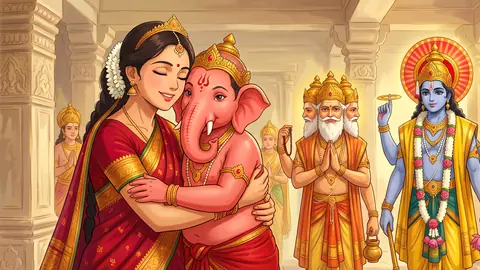
Not seeing her husband anywhere, Kalavati fell to the ground, weeping. “Who can know the greatness of Satyadeva?” cried Lilavati, and drew her into her lap. Kalavati took up her husband’s sandals. She meant to follow him.
“Satyadeva has taken him,” thought Sadhu, and lay flat before the Lord again and again.
A voice came from the sky. “Your daughter left the prasad to see her husband. Let her go home, eat it and come back, and she will have him again.”
 Under a great banyan, King Tungadhvaja in a green dhoti stands apart with his bow, chin raised, a leaf of prasad untouched at his feet, while two cowherd men, two women and a boy sit eating prasad beside the vow’s brass pot, two cows grazing behind.
Scene 9 of 9
Under the banyan
Kalavati hurried home, ate the prasad, and came back. There stood her husband among their people. “Father, come home. Why do you wait?” From then on, Sadhu kept the vow at full moon and sankranti.
Then Suta told of King Tungadhvaja, who cared for his people. After hunting in the forest, he came to a banyan where cowherds and their kin were worshipping Satyadeva. Pride kept the king away. He did not bow. They set the prasad beside him and went back to eat. He left it lying there.
His hundred sons were lost, his wealth gone. “Satyadeva has done this. I will go where he is worshipped.” He worshipped with the cowherds, in devotion and faith. By Satyadeva’s grace he had wealth and sons.
You’ve reached the end of this story.
The end
How this story closes
He worshipped with the cowherds, in devotion and faith.