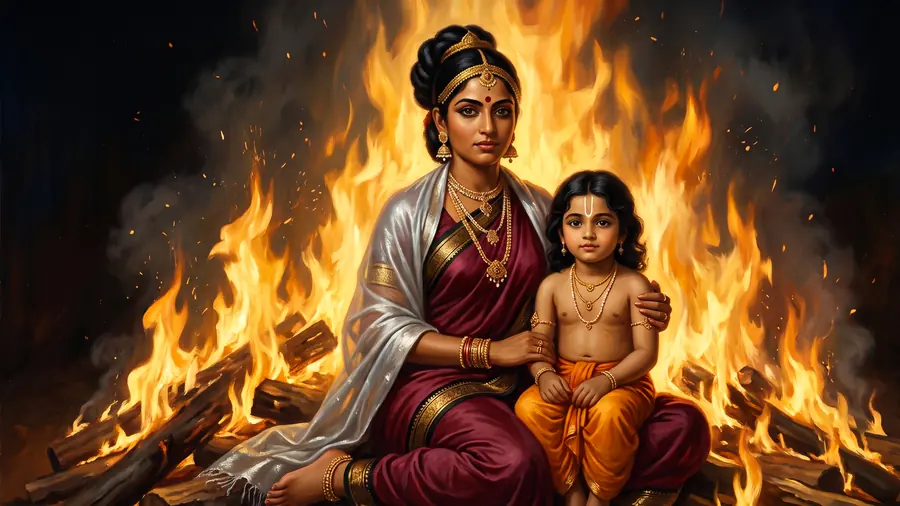
In the Bhagavata, fire cannot harm the boy. At Holi, a bonfire remembers the aunt who sat in the flames with him in her lap.
Holika Dahan. Also known as: Prahlada and Holika, the Holi bonfire.
Tap an underlined word for its meaning.
 In a lamplit stone chamber of carved pillars and flat lintels, the crowned king Hiranyakashipu sits holding his small son Prahlada on his lap, tears running down his cheeks, while the garlanded boy smiles with joined palms and the bearded teacher Shanda stands watching with his manuscripts.
Scene 1 of 6
Tears on a smiling face
Bathed and adorned by his mother, Prahlada was brought in and bowed at his father’s feet. Hiranyakashipu gathered him into his arms, set him on his lap and breathed in the scent of his hair. His tears fell on the child’s smiling face.
“Long may you live, my son. Tell me the best of what you have learned.”
“To hear of Vishnu,” said Prahlada, “to sing of him, remember him, serve and worship him, pray to him, be his servant and friend, and give him everything.”
The king’s lips trembled. He turned on the teacher Shanda. “You taught him this!”
“Not I, king, nor anyone. It grew in him.”
The boy spoke again. Hiranyakashipu flung him from his lap. “Take him away. Kill him.”
 In a vast, dim stone hall of carved pillars, flat lintels and a flat coffered ceiling, a shaft of light falling from a high rectangular window onto the polished floor, King Hiranyakashipu stands in his crown, armour and golden cape with his head bowed, brooding, one hand resting on the hilt of his sword.
Scene 2 of 6
Wind, fire, water
Coppery-bearded and sharp-toothed, the king’s servants came with tridents, shouting, “Cut him! Pierce him!” Prahlada sat silent, his mind on the Lord. The blows did nothing.
Afraid now, the king tried other ways. The feet of great elephants. Huge serpents. Spells. A fall from a hilltop. Illusions. A prison. Poison. Hunger. Cold, and wind, and fire, and water. Heavy stones.
None of it could kill his son.
He fears nothing, thought the king. His strength is endless. My enmity with him will be my death. Or perhaps not. So thinking, Hiranyakashipu stayed silent, his face to the ground, his glow somewhat dimmed.
Fire was on that list. One word, between wind and water. The Bhagavata says no more.
 On a starry night, a great bonfire of logs, branches and cow-dung cakes blazes in an empty village ground, its sparks and smoke rising past thatched huts on wooden posts and old trees.
Scene 3 of 6
A fire with a name
Night falls on the eve of Holi, and a bonfire is lit. It has a name: Holika Dahan, the burning of Holika.
The story told of that fire is not in the Bhagavata. It belongs to later tradition and to the festival itself, and its tellings do not all agree. Many stories have gathered around Holi. This is one of the three told most often.
Here the quarrel is simple. The king wanted everyone in his kingdom to worship him. His own son, devoted to Vishnu, would not. Hiranyakashipu tried again and again to kill the boy, and nothing he did could touch him.
Then the king’s sister stepped into the story.
 In a lamplit stone hall, Holika, the king’s sister, stands composed in a maroon silk sari and a gold diadem, a shimmering silver-white scarf over her shoulders and a faint smile on her face.
Scene 4 of 6
The king’s sister
Her name was Holika, and fire could not burn her.
Why? Here the tellings part ways. Some say she had received a boon that kept the flames from her. Others say it was something she wore, a scarf or a cloak that fire would not touch.
Whose plan was it? They part again. In some, the king asked his sister for help. In others, she offered it herself.
Either way, the plan was fire. A pyre would burn. Holika would sit in it with Prahlada in her lap. Her protection would hold. The boy, with nothing to protect him, would not come out.
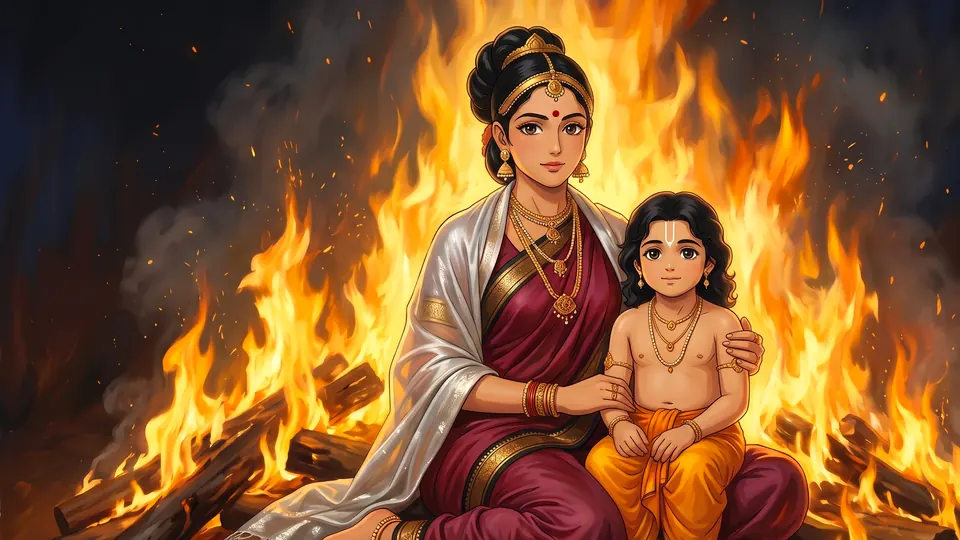
 Amid the roaring flames of a burning pyre at night, Holika sits upright in her maroon sari and silver-white scarf with the boy Prahlada on her lap, her arm around him, both of them whole as the fire rises around them.
Scene 5 of 6
In the fire
The pyre burned. Holika sat in it, the boy in her lap.
It did not end as planned. Holika burned to death. Prahlada came out of the fire unharmed.
So the story goes. The tellings differ on how it happened. In one, the boy kept chanting the name of Vishnu and came through unscathed. In another, her protection left her and passed to him, for he was devoted to Vishnu. In another, as the fire rose, the cloth flew off Holika and covered the boy instead.
The king’s sister was gone. His son, once again, was alive.
 At night, villagers in classical dress walk up to the Holika Dahan bonfire with offerings: a young woman raises a coconut to cast into the flames, an old man scatters green wheat and holds ears of barley, a mother carries a brass plate of cow-dung cakes with her small son holding her sari, and an old woman follows with joined palms, while more villagers stand by the fire.
Scene 6 of 6
The night before Holi
That burning is what the bonfire remembers. It is lit on the night before Holi, in North India and Nepal, in Maharashtra, Assam and beyond. The night has another name too: Chhoti Holi. Customs change from place to place. People walk around the fire. Into it go coconuts, barley, wheat and cakes of cow dung. In the south the same night keeps another fire and another story, Kama Dahanam, when Shiva burned Kama, the god of love. Then morning comes. It is Holi, and the colours fly.
The Bhagavata carries Prahlada’s story on to his father’s assembly hall, where the king asks whether the Lord is in this pillar, strikes it with his fist, and Narasimha comes out of it.
You’ve reached the end of this story.
The end
How this story closes
That burning is what the bonfire remembers.