A king no creature can kill asks his young son: is your god in this pillar?
Prahlada and Narasimha. Also known as: Narasimha Avatar.
Tap an underlined word for its meaning.
 At sunset over a green valley, four-faced Brahma rides down on a white swan and pours water from a brass pot toward a grass-and-bamboo anthill, from which a golden-skinned, crowned Hiranyakashipu has risen amid glowing heat.
Scene 1 of 9
Out of the anthill
Brahma’s swan came down over the valley of Mandara, and the Creator saw only an anthill, overgrown with grass and bamboo. Yet the air around it burned. Inside, the ants had eaten the ascetic to the bone, and still he breathed, still he heated the worlds like a sun behind cloud. Brahma smiled in wonder. “Rise, son of Kashyapa. Ask.”
He sprinkled water from his kamandalu. Hiranyakashipu rose from the mound young and whole, gleaming like molten gold, the way fire leaps out of kindling.
Then he asked. Let nothing you made kill me. Not indoors, not outdoors. Not by day, not by night. Not on the ground, not in the sky. No weapon. No man. No beast.
Brahma granted it all.
 At dusk outside a smoking palace city, the sage Narada, veena on his shoulder, raises his palm to Indra, who holds the wrist of the weeping, pregnant queen Kayadhu.
Scene 2 of 9
The captive queen
While the king stood buried in his anthill, the gods had marched on his city. The asura chiefs fled, leaving their families behind. Indra’s army stripped the palace, and Indra himself led the queen away. She was carrying a child, and she cried like a kurari bird in a vulture’s claws.
Narada appeared before them. “Let her go. She has done no wrong.”
“The demon’s seed is in her womb,” said Indra. “We keep her until it is born.”
“The child inside her is a great devotee of the Lord. You cannot kill him.”
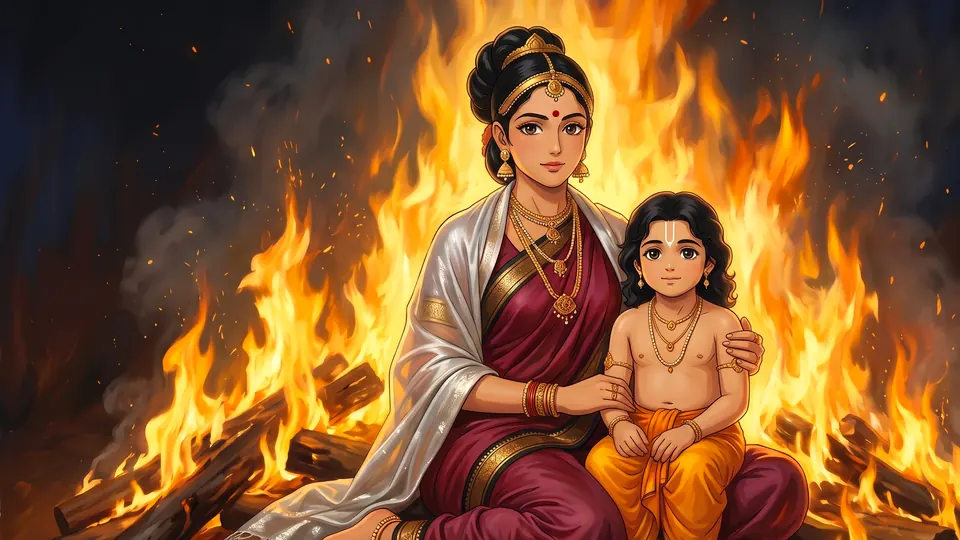
Indra let her go. In Narada’s hermitage, for a long time, the taught the mother, and the unborn boy listened. She would forget. He never would.
 Hiranyakashipu sits alone on a throne atop coral-red steps in a heavenly hall of crystal pillars and emerald floors, sword in hand, with heaps of gold vessels, jewels and silks piled at the foot of the steps.
Scene 3 of 9
The throne of Indra
Hiranyakashipu came home with a body of gold and a dead brother burning in his heart, and it was Vishnu he blamed. He conquered the three worlds and took his seat in Indra’s own palace, where coral steps rose to floors of emerald and walls of crystal, and anklets chimed through rooms of gems. His coppery eyes rolled with wine. Every power in creation brought him gifts with its own hands, all but Brahma, Shiva and Vishnu.
The exiled gods prayed without sleep. Then a voice spoke out of the empty air, deep as a rain cloud.
“Do not fear. When he torments his own son Prahlada, a boy with no enemy in the world, I will kill him, boon or no boon.”
 In a lamplit palace chamber, Hiranyakashipu holds little Prahlada on his lap, his face pressed to the boy’s hair with tears of joy, while the boy looks up with palms joined.
Scene 4 of 9
On his father’s lap
The boy was five. Each day he sat in the school of Shanda and Amarka, sons of the priest Shukracharya, learning the craft of kings: who is a friend, who is an enemy. He recited it all, and loved none of it.
One day, bathed and adorned by his mother, he was brought before the king. Hiranyakashipu lifted his son onto his lap, breathed in the scent of his hair, and wept for joy. “Tell me, child, the best thing you have learned.”
Prahlada told him: to hear of Vishnu, to sing of him, to remember him, to serve him, to give him everything.
The king’s lips trembled. He threw the boy from his lap to the floor. “Take him away. Kill him.”
 Under a starry sky in a stone courtyard, three turbaned, copper-bearded guards thrust tridents at Prahlada, who sits cross-legged with eyes closed and palms joined in a soft glow, the prongs stopping short of him.
Scene 5 of 9
Nothing touched him
The guards came, copper-bearded and sharp-toothed, shouting, “Cut him! Pierce him!” and drove their tridents at the soft places of a child’s body. Prahlada sat silent, his mind on the Lord. The blows fell as if on nothing.
So the king tried everything. He threw his son under the feet of great elephants and among huge serpents. He worked spells and illusions. He poisoned him, starved him. He left him to bitter cold and wind, to fire and water. He hurled him from a hilltop and dropped heavy stones on him.
Nothing touched the boy.
At last Hiranyakashipu sat with his face to the ground, the glow gone from his skin. He fears nothing, he thought. Perhaps it is I who will die.
 In a sunlit pillared hall, Hiranyakashipu, risen from his throne with sword raised, points furiously at a carved stone pillar while young Prahlada stands calmly across the hall with hands folded.
Scene 6 of 9
Is he in this pillar?
The frightened teachers went to the king. In free hours the boy had taught the other asura children, and now every one of them had turned to Vishnu.
The king’s body shook. He hissed like a snake someone has stepped on. Before him stood Prahlada, hands folded, calm.
“When I am angry, the three worlds tremble with their rulers. By whose strength do you stand there without fear?”
“By the same strength that is yours, father. There is only one, and it holds everyone, Brahma too.”
“You talk like someone who wants to die. This lord of yours who is everywhere, where is he?” He seized his sword. “Is he in this pillar? I will take your head. Let your god come and save you.”
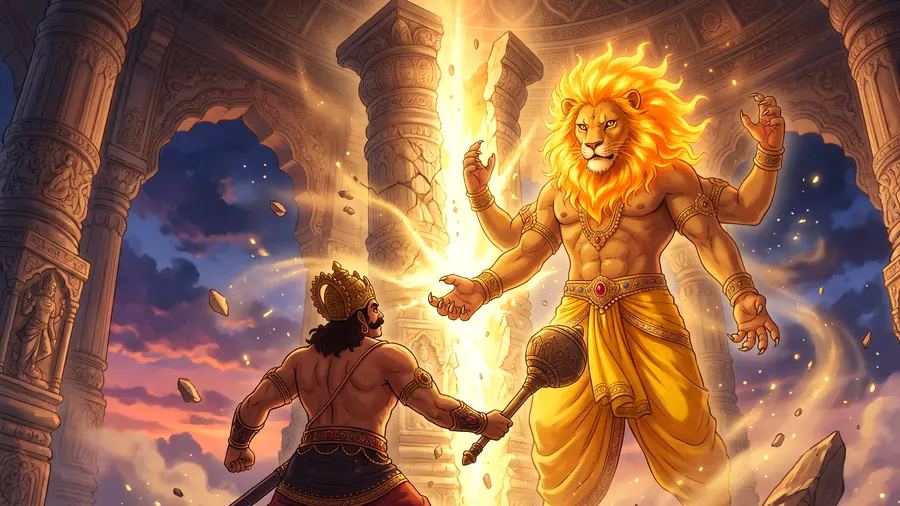
 In a blaze of golden light the stone pillar splits apart and the towering four-armed Narasimha, lion-headed with a fiery mane, steps out, as Hiranyakashipu, seen from behind, charges at him with a mace under a twilight sky.
Scene 7 of 9
Neither man nor lion
He rose from his throne and struck the pillar with his fist.
A sound broke from the stone as if the shell of the universe had cracked. It reached the world of Brahma, and the gods thought their heavens were falling. The asura lords searched the hall for its source.
Out of the pillar stepped a form never seen before, neither man nor lion. Eyes like molten gold. A blazing mane. A body that touched the sky. Arms in every direction.
Hiranyakashipu took up his mace and charged. The Lord caught him, let him slip, caught him again, laughing.
At the doorway of the hall, as day turned to night, Narasimha laid the king across his thighs and ended him with his nails.
 Four-armed Narasimha, seated on a throne in a firelit hall, gently rests his hand on the head of Prahlada, who kneels before him with tears in his eyes and palms joined.
Scene 8 of 9
A boy before the lion
Then Narasimha sat down on the king’s throne, blazing, and no one dared come near. Brahma, Shiva, Indra and all the gods stood back, palms joined. They begged Lakshmi to go to him; even she had never seen him like this, and she held back.
Brahma turned to the boy at his side. “Child, go to him. Calm him.”
Prahlada walked forward slowly and lay full length at the Lord’s feet.
Narasimha lifted him up and set his hand on the boy’s head. Tears filled Prahlada’s eyes. In a faltering voice he began to pray. “I do not fear your jaws or your blazing eyes, or the roar that sends elephants running. I fear only this world. When will you call me to your feet?”
 At dawn, young Prahlada, wearing a small gold crown, sits with palms joined on his father’s golden throne under a red canopy, as four-faced Brahma on a lotus and the sage Shukracharya in saffron raise their hands in blessing.
Scene 9 of 9
On his father’s throne
The anger left the Lord’s face. “Prahlada, gentlest of your line, I am pleased with you. Ask for anything.”
The boy smiled a little. “Do not tempt me. If you must give, let no desire ever grow in my heart.”
“Then rule your father’s kingdom, and keep your mind on me.”
“One thing more. My father raged at you, not knowing who you are. Forgive him.”
“He is already purified, and twenty-one of your forefathers with him, because you were born in that house. Go and perform his rites.”
The son performed his father’s rites. The Lord vanished. Brahma and Shukracharya crowned the boy king of the asuras. The child who had been thrown from his father’s lap now sat on his father’s throne.
You’ve reached the end of this story.
The end
How this story closes
The child who had been thrown from his father’s lap now sat on his father’s throne.