Spritual
Spritual
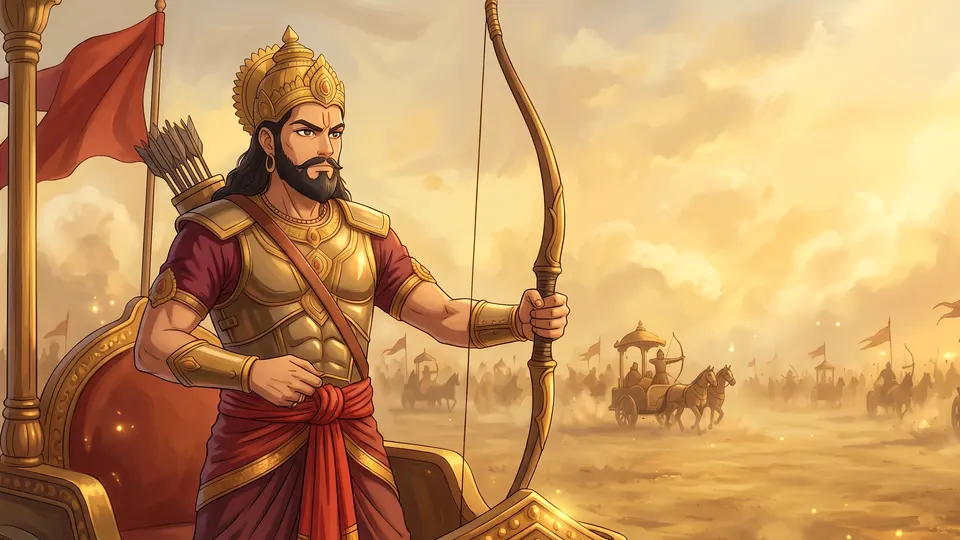
Shikhandi, a bearded Panchala prince in a gold war crown and bronze-and-gold armour over crimson, stands in his chariot gripping his great bow, his face set in fierce resolve, with the Pandava chariots advancing through the dust of Kurukshetra behind him.

Mahabharata

Shikhandi

शिखंडी

Panchala prince · Son of Drupada

Shikhandi, son of Drupada and a prince of Panchala, was once a woman and later became a man; Bhishma himself calls him brave, fierce in battle and ever victorious. Because Shikhandi had been a woman, Bhishma would not fight him, and told the Pandavas so on the night before the tenth day.

Read more

At sunrise on the tenth day Shikhandi rode in the van, with Bhima and Arjuna guarding his wheels. Later that day he swore to kill the grandsire, and struck him with arrows again and again while Arjuna shot from behind. Ganga mourned her son as slain by Shikhandi; Krishna told her it was Arjuna who felled him.

  • 1 story
  • 9 scenes
  • 9 min read

Stories with Shikhandi

MahabharataBhishma Parva

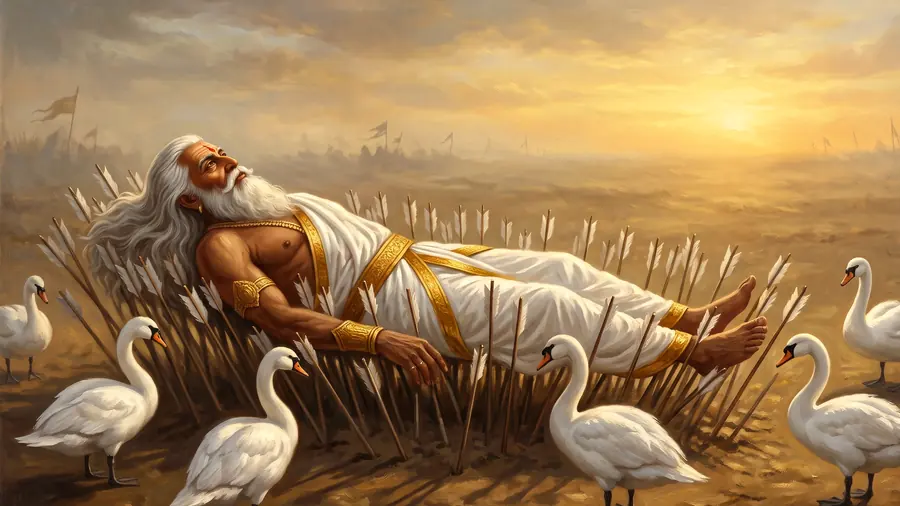
Bhishma on the bed of arrows: A bed of arrows

He told the Pandavas how to bring him down. Then, held above the earth by arrows, he lay there fifty-eight nights and gave up his life only after the sun had turned north.
  • 9 min
  • Resolve
  • Self-control

Names

Shikhandi. Also known as: Panchala prince.

Where this comes from

What this page about Shikhandi was checked against: each point, and where it is found.
  1. Son of Drupada; “was a female before but subsequently obtained manhood”; Bhishma calls him “wrathful in battle, brave, and ever victorious”; Bhishma will not strike him and tells the Pandavas to let Arjuna attack with Shikhandi before him: Bhishma Parva, Section CVIII Sources of the story “Bhishma on the bed of arrows”
  2. Prince of the Panchalas: Bhishma Parva, Section CX (Dhritarashtra’s question) and Section CXVII; son of Yajnasena (Drupada), made female and later male: Section CXIII (Drona) Sources of the story “Bhishma on the bed of arrows”
  3. On the tenth day, “towards the hour of sun-rise”, placed in the very van, Bhima and Arjuna protecting his car-wheels; later, after “Then commenced the battle” and “in that battle on the tenth day”, pierces Bhishma with three shafts in the chest; swears to slay him (“look thy last on this world”), then pierces him with five shafts; only then Arjuna: “I will fight behind thee”: Bhishma Parva, Section CIX (m06109) Sources of the story “Bhishma on the bed of arrows”
  4. Bhishma does not strike him, remembering his femininity: Sections CXVIII and CXIX; Shikhandi, “protected in the battle by the diadem-decked (Arjuna)”, pierces Bhishma with ten shafts and later strikes his chest with nine arrows; Arjuna shoots with Shikhandi placed before him, and Bhishma says the arrows that pain him are Arjuna’s, not Shikhandi’s: Section CXX (m06120) Sources of the story “Bhishma on the bed of arrows”
  5. Ganga laments her son slain by Shikhandi; Krishna answers that Dhananjaya slew him, not Shikhandi: Anushasana Parva, Section CLXVIII (m13b133) Sources of the story “Bhishma on the bed of arrows”

Reading comfort

Text size
Colour

Colour waits while Night Lamp is on.

Motion

Light mode keeps the paintings still, with one slow drift and no depth effect. Easier on older phones and batteries.

Night Lamp

Warm amber text on near-black. Paintings fade slowly and hold still.

Rama turned to his teacher and asked for the knowledge of withdrawal.

Saved on this device.