A scroll world
The Fourteen Lokas
The Vishnu Purana counts seven spheres from earth up to Satya-loka and seven regions of Patala below. Scroll down through them, in its own names and words.
Scroll to travel
Painting from the story “A mountain for a churning rod”
Satya-loka
The sphere of truth, the inhabitants of which never again know death.
Painting from the story “A mountain for a churning rod”
Tapo-loka
The sphere of penance, inhabited by the deities called Vaibhrajas, who are unconsumable by fire.
Painting from the story “A mountain for a churning rod”
Jana-loka
Here Sanandana and other pure-minded sons of Brahma reside.
Painting from the story “The unmoving star”
Mahar-loka
The sphere of saints, above Dhruva. Its inhabitants dwell in it throughout a Kalpa, or day of Brahma.
Painting from the story “The unmoving star”
Swar-loka
The heavenly sphere: the interval between the sun and Dhruva, the pole-star.
Painting from the story “The dog at heaven’s door”
Bhuvar-loka
The atmospheric sphere: the region that extends from the earth to the sun, in which the Siddhas and other celestial beings move.
Painting from the story “The dog at heaven’s door”
Bhur-loka
The sphere of the earth: wherever earthy substance exists, which may be traversed by the feet.
Painting from the story “Three steps across the worlds”
Below the earth
Its depth below the surface is said to be seventy thousand yojanas, each of the seven regions of Patala extending downwards ten thousand.
The sage Narada, returning from those regions, said that there the rays of the sun diffuse light, and not heat, by day, and the moon shines by night for illumination, not for cold.
Painting from the story “Three steps across the worlds”
Atala
Named first among the seven regions of Patala. Its soil is white.
Painting from the story “Three steps across the worlds”
Vitala
Named second. Its soil is black.
Nitala
Named third. Its soil is purple.
Gabhastimat
Named fourth. Its soil is yellow.
Mahatala
Named fifth. Its soil is sandy.
Sutala
Named sixth. Its soil is stony.
Patala
Named seventh. Its soil is of gold.
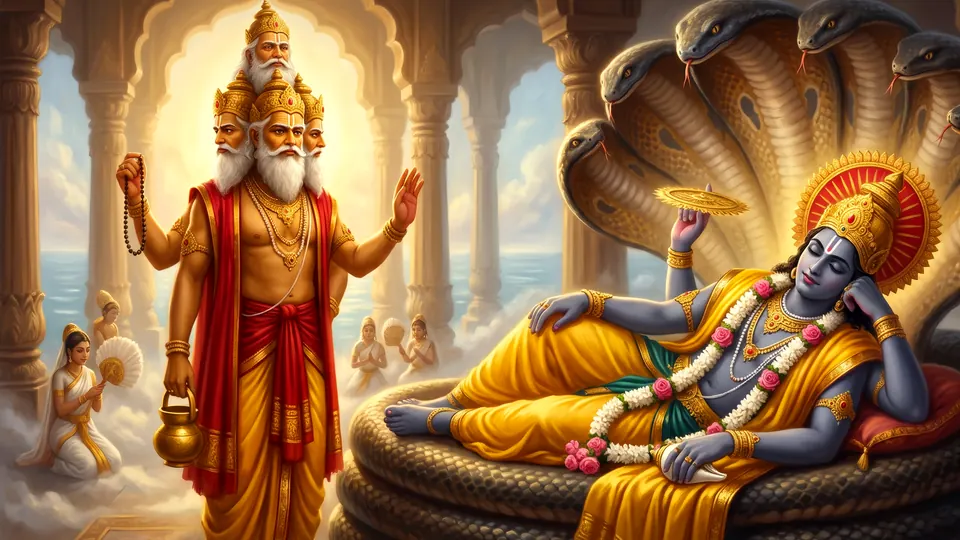
Sesha, called Ananta
Below the seven Patalas is the form of Vishnu which is called Sesha. He has a thousand heads, and the thousand jewels in his crests give light to all the regions.
Sesha bears the entire world, like a diadem, upon his head, and he is the foundation on which the seven Patalas rest.
Painting from the story “The fire with no end”
How this was made
The names and every line are from the Vishnu Purana, Book 2, chapters 5 and 7, lightly shortened from H. H. Wilson’s English translation of 1840. The Purana describes the seven spheres from the earth upward, and it names the seven regions of Patala in one list without saying which lies above which. Travelling from Satya-loka downward, with the seven regions in the order of that list, is this page’s own arrangement. Seven spheres and seven regions of Patala make the fourteen; the Purana itself counts them as seven and seven. Wilson notes that other Puranas name the lower seven differently: the Bhagavata and the Padma have Atala, Vitala, Sutala, Talatala, Mahatala, Rasatala and Patala. The colours of the seven lower regions follow the soils the text gives them: white, black, purple, yellow, sandy, stony and gold. The colours above the earth, the light and the drifting motes are this page’s own drawing, and are not from the text.
The paintings in this scroll are illustrations from other stories on this site, set behind the names for atmosphere, each with the story it comes from. They are not pictures of the lokas. Where a band has none, it waits for its own painting.
Sources
More scroll worlds
 A scroll worldHanuman’s LeapFrom Mahendra mountain, across a hundred yojanas of ocean, to the shore of Lanka. Scroll, and travel it with him.
 A scroll worldThe Descent of GangaThe river of heaven falls, is lost for years in Shiva’s hair, and runs free to the sea. Scroll, and the water comes down beside the words.