Following the sage Vishvamitra, young Rama faces a yakshi strong as a thousand elephants; then, near Mithila, he enters a hermitage where a woman has lived unseen for thousands of years.
Tataka and Ahalya. Also known as: Tataka vadh, Ahalya moksha.
Tap an underlined word for its meaning.
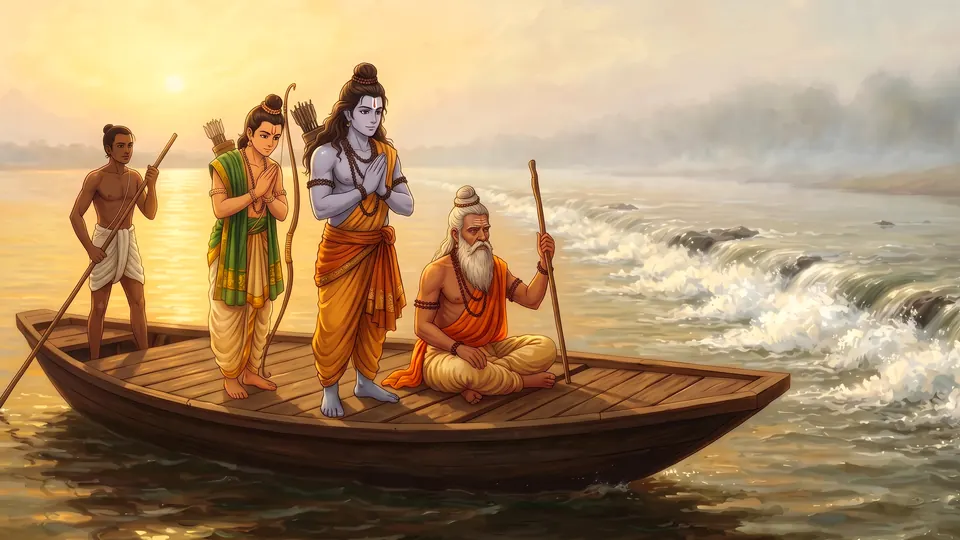 At dawn on the wide Ganga, Vishvamitra sits cross-legged in a flat plank ferry while a boatman poles at the stern and young Rama and Lakshmana stand with joined palms, the white, roaring line where the Sarayu meets the river breaking beside them.
Scene 1 of 9
A roar in midstream
The boat was halfway across the Ganga when Rama heard it: a roar rising out of the river, like water tearing water.
At first light the of the hermitage had brought a good boat to the bank. “Go aboard, with the princes before you,” they told Vishvamitra.
Now, in midstream, Rama turned to the . “What is this great noise?”
“On ,” said Vishvamitra, “Brahma made a lake with his mind: Manasa. The river that flows out of it runs round your . That is the Sarayu, and here she meets the Ganga. What you hear is their waters striking. Bow to them both, Rama.”
The brothers bowed. The boat touched the southern bank.
And there the forest began.
 On the southern bank, Vishvamitra gestures toward a dark, tangled forest while Rama, with a raised hand, questions him and Lakshmana stands at his side with his bow; a tiger and two elephants lurk among the trunks and birds circle above.
Scene 2 of 9
No road in
No path led in. Crickets shrilled. Vultures screamed, and among the dhava, arjuna and bilva trees moved tigers, boars and elephants.
“What terrible forest is this?” Rama asked.
“Once, child, two rich lands stood here, the work of the gods: Malada and Karusha. Indra himself blessed them, and for a long age they prospered. Then there was a yakshi. She takes any form she likes. She has the strength of a thousand elephants. She is the wife of Sunda, and her son is Maricha, mighty as Indra. Her name is Tataka.
“She lives a yojana and a half from here, and no one can enter. Trust the strength of your own arms, Rama. At my word, clear this land of its thorn.”
 In a vision of the past, the yakshi Tataka and her son Maricha rush in fury at the sage Agastya, she with grasping hands, he swinging a club; Agastya stands before a thatched hermitage with a water-pot and one finger raised to speak the curse.
Scene 3 of 9
Suketu’s daughter
But Rama had a question. “Yakshas, they say, have little strength. How does a yakshi, a woman, carry the strength of a thousand elephants?”
“By a boon,” said Vishvamitra. “Listen.
“There was a great yaksha, Suketu, childless. He did hard tapas, and Brahma, pleased, gave him a jewel of a daughter, Tataka, with that strength. A son he did not give.
“Suketu married her to Sunda, Jambha’s son, and she bore Maricha.
“Then Sunda was slain. Tataka and her son rushed at the Agastya, roaring. ‘Become a rakshasa,’ Agastya told Maricha. And to her: ‘Lose this form, great yakshi. Become a man-eater, misshapen, terrible to see.’
“Maddened by that curse, she lays waste the land where Agastya once walked.”
 In the dark forest young Rama stands with joined palms and bowed head before Vishvamitra, who lifts a hand in command, while Lakshmana waits beside him with his bow.
Scene 4 of 9
A kingdom’s burden
“For the good of cows and brahmanas, Rama, kill her. No one but you in the three worlds can slay her.
“Feel no pity that she is a woman. A king’s son must do this for the good of all four orders. A protector does what protection demands, harsh or gentle, sinful or blameworthy. That is the age-old duty of all who bear a kingdom’s burden. There is no in her.
“Indra slew Virochana’s daughter Manthara, who wished to destroy the earth. Vishnu slew Bhrigu’s wife, Shukra’s mother, who wanted a world without Indra.”
Rama joined his palms.
“In , among the elders, my father commanded me, and his word cannot be set aside. I will do it.”
 Rama draws his bow with an arrow on the string as Lakshmana and Vishvamitra stand beside him, and the gaunt, wild-haired yakshi Tataka rushes at them out of the trees, arms raised and roaring, through dust and falling stones.
Scene 5 of 9
The bowstring
He closed his fist on the middle of the bow and twanged the string. The sound filled every direction.
Tataka heard, and rage took her. She came running toward the sound.
“Look at her, Lakshmana,” said Rama. “A coward’s heart would burst. Yet her womanhood shields her; I have no heart to kill her. I will take only her strength and her movement.”
He was still speaking when she charged, arms raised, roaring. Vishvamitra rebuked her with a shout. “Be safe, Raghavas! Be victorious!”
Dust swallowed the brothers. Then stones fell like rain.
Rama’s arrows met the stones, and maimed her arms as she came on. Lakshmana, roused, maimed her too. She changed shape, and shape again.
Then she vanished.
 Against a low red sun at dusk, Rama stands with his bow fully drawn as the wild-haired Tataka, arms spread, comes down at him out of the red sky, while Indra, palms raised, and four gods with palms joined watch from a golden cloud.
Scene 6 of 9
Before the sun sets
Stones kept falling from every side.
“Enough pity, Rama,” Vishvamitra called. “She is a breaker of sacrifices, and her magic will soon restore her. The sun is about to set. Kill her before dusk. At dusk, rakshasas grow hard to overcome.”
Rama shot at sound alone, and his arrows hemmed her in.
She came down on the brothers like a thunderbolt. One arrow struck her chest. She fell, and was dead.
“Well done!” cried Indra and the gods. “Show the prince your favour,” they told the . Vishvamitra kissed Rama’s head. That same day the forest, freed of its curse, shone like the grove of Chaitraratha.
The weapons the gave Rama at daybreak are told in “The bow that broke the sky”.
 At the edge of Mithila, Vishvamitra, Rama and Lakshmana stand before an old, silent hermitage of thatched huts, and Rama gestures toward it, asking whose it was.
Scene 7 of 9
The empty hermitage
“Whose hermitage was this?” Rama asked.
Their stay at Siddhashrama was behind them, and the slaying of the rakshasas. After a night as guests of King Sumati they had come in sight of Janaka’s , and the with them cried, “Splendid!” But at the city’s edge stood a hermitage: old, lovely, and empty.
“Gautama’s,” said Vishvamitra. “Here he did tapas for many years, with his wife Ahalya.
“Indra saw his chance. He came wearing the ’s own form, and asked Ahalya to be his. She knew the thousand-eyed god under the hermit’s dress. Curious about the king of the gods, she consented.
“‘Go quickly,’ she told him after. ‘Guard yourself and me from Gautama.’
“Indra hurried out, and met Gautama coming in.”
 In a vision of the past, the sage Gautama, fresh from his bath with firewood and kusha grass in his arms, raises his hand to speak the curse while his wife Ahalya stands before him with bowed head and joined palms.
Scene 8 of 9
Unseen
“Gautama came fresh from the bathing place, bright as fire, firewood and kusha grass in his hands. Indra’s face fell.
“‘You took my form and did what must not be done,’ said the , and cursed him. Indra bore that curse from that moment.
“Then Gautama turned to his wife.
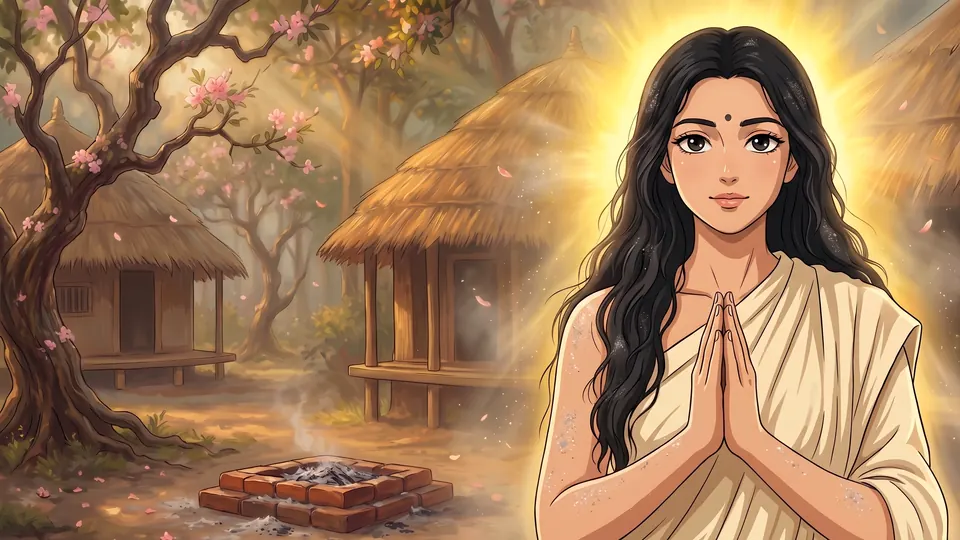
“‘For many thousands of years you will stay here. No food; air alone. Lying in ash, burning in tapas, unseen by any living being. When Rama, Dasharatha’s son, comes into this grim forest, you will be made pure. Welcome him as a guest and, free of greed and delusion, you will have your own form again, beside me, in joy.’
“He left for a peak of the Himalaya. Now go in, Rama. Deliver her.”
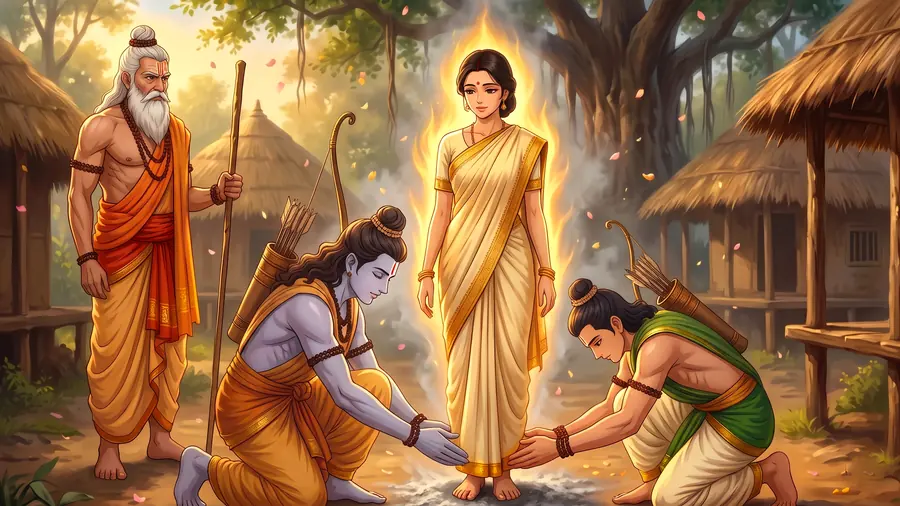
 Ahalya, visible at last, stands glowing in the light of her tapas, her hair in a low bun, in the hermitage yard with grey ash on the ground about her feet, as Rama and Lakshmana kneel and clasp her feet, Vishvamitra stands near with his staff, and petals fall from the sky.
Scene 9 of 9
Her feet
Rama went in behind the , Lakshmana with him, and saw her.
She blazed with her tapas, too bright for gods or asuras to look at: a flame wrapped in smoke. By Gautama’s word the three worlds could not see her until Rama did. The curse was over; she was visible.
The two princes clasped her feet, gladly.
Remembering Gautama’s words, Ahalya welcomed them as guests, with water for their feet. Flowers rained; divine drums sounded. Gautama, joyful, rejoined her and honoured Rama.
Then Rama took the road to .
Later tradition, not Valmiki: in Valmiki, Ahalya is unseen, not stone. The stone that wakes at the touch of Rama’s foot is the later telling, best known from the Ramcharitmanas (Bal Kand) and Adhyatma Ramayana.
You’ve reached the end of this story.
The end
How this story closes
Then Rama took the road to Mithila.