Spritual
Spritual
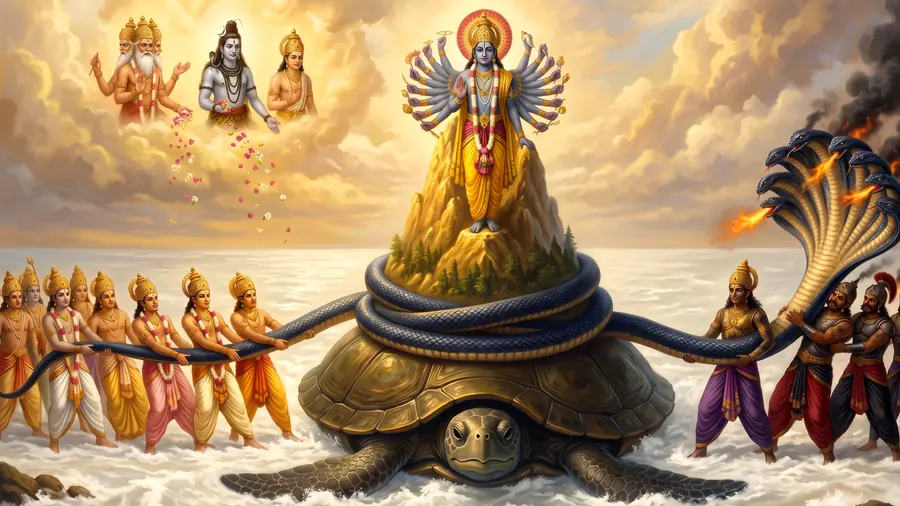
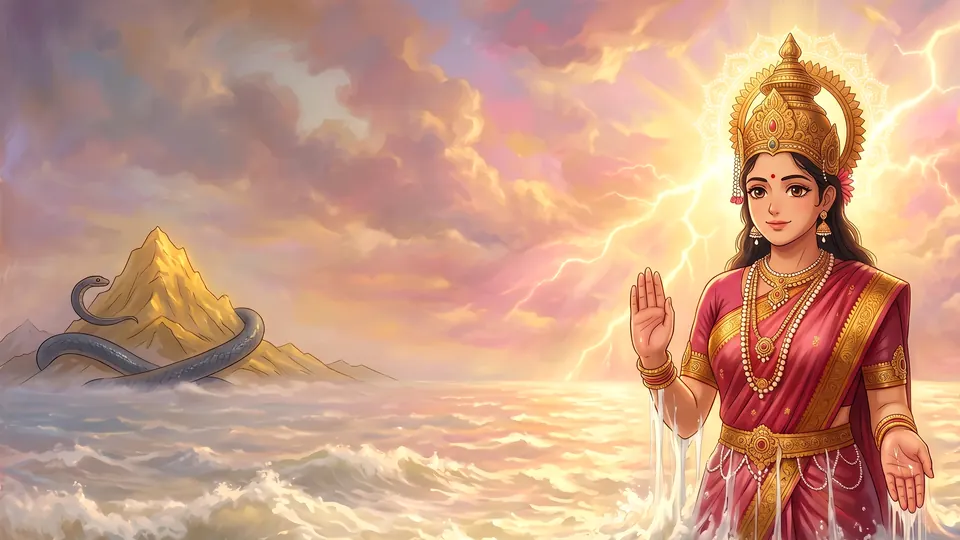
Lakshmi, crowned in gold and dressed in a rose-red silk sari with pearls, rises waist-deep from the foaming Ocean of Milk with one hand raised in blessing and the other open in giving, as lightning-bright light floods the sky and the golden mountain wound by the great serpent stands far off in the sea.

Gods & Puranas

Lakshmi

लक्ष्मी

Shri · Jaganmata

Lakshmi is Shri, goddess of fortune, worshipped as the world’s eternal mother. When Durvasa’s curse left the worlds without Shri, she rose from the churned Ocean of Milk like lightning.

Read more

Garland in hand, she sought unwavering goodness and found austerity without mastery of anger, dharma without kindness. She chose Vishnu, who needed no one, and made his chest her home; her merciful glance made the worlds flourish again. Whenever he descends, she comes too: as Sita, as Rukmini.

  • 1 story
  • 9 scenes
  • 9 min read

Stories with Lakshmi

Vishnu & KrishnaSkandha 8

Samudra Manthan: A mountain for a churning rod

Gods and asuras churn the ocean for nectar. Poison rises first, then treasures and a goddess, and last a pot of nectar that is poured for one side alone.
  • 9 min
  • Persistence
  • Compassion

Names

Lakshmi. Also known as: Shri, Jaganmata.

Not to be confused with Lakshmana, Rama’s brother.

Where this comes from

What this page about Lakshmi was checked against: each point, and where it is found.
  1. Name Lakshmi: 8.8.10, 8.8.14, 8.8.17, 8.8.19; title Shri and Rama: 8.8.8 (Sanskrit “shri rama”); Rama again in 8.8.23 Sources of the story “Samudra Manthan”
  2. Rose from the Ocean of Milk: 8.8.8 Sources of the story “Samudra Manthan”
  3. Chose Vishnu (Mukunda), who needs no one: 8.8.23 (Sanskrit ‘nirapeksham’) Sources of the story “Samudra Manthan”
  4. Light like lightning colouring the directions: 8.8.8 Sources of the story “Samudra Manthan”
  5. All wanted her (gods, asuras, men): 8.8.9 Sources of the story “Samudra Manthan”
  6. Indra brings a seat: 8.8.10; elephants of the directions bathe her: 8.8.14; Brahma gives a lotus: 8.8.16 Sources of the story “Samudra Manthan”
  7. Walks with a lotus garland and finds every candidate wanting (tapas without conquest of anger, knowledge not free of attachment, Sanskrit ‘sanga-varjitam’): 8.8.17, 8.8.19-22 Sources of the story “Samudra Manthan”
  8. Garland on Mukunda’s shoulders: 8.8.24 Sources of the story “Samudra Manthan”
  9. His chest her home: 8.8.24-25 Sources of the story “Samudra Manthan”
  10. Her glance enriches the gods: 8.8.25, 8.8.28; asuras downcast at being passed over: 8.8.29 Sources of the story “Samudra Manthan”
  11. For the title ‘Jaganmata’ and the line ‘the world’s eternal mother’ (Hindi ‘नित्य जगन्माता’): Parashara says Shri is eternal, the mother of the world, never parted from Vishnu (Sanskrit ‘nityaivaiṣā jaganmātā viṣṇoḥ śrīr anapāyinī’); Wilson: ‘Śrī, the bride of Viṣṇu, the mother of the world, is eternal, imperishable’. ‘jaganmātā’ again at 1.8.30. Vishnu Purana 1.8.17, 1.8.30 (Sanskrit; tr. H. H. Wilson, 1840)
  12. Same passage in Wilson’s public-domain translation (Book I, ch. 8). Vishnu Purana 1.8 (tr. H. H. Wilson)
  13. For the line ‘mother of the three worlds’ (Hindi ‘तीनों लोकों की माता’): the Lord, father of the three worlds, made his chest the home of Shri, the mother (Sanskrit ‘tasyāḥ śriyas tri-jagato janako jananyāḥ vakṣo nivāsam akarot’). The same verse continues ‘śrīḥ svāḥ prajāḥ… aidhayata… tri-lokān’: Shri made her own children (svāḥ prajāḥ), the three worlds, prosper. Indra’s hymn in Vishnu Purana 1.9 (Wilson): ‘Thou art the mother of all beings, as the god of gods, Hari, is their father.’ Bhagavata Purana 8.8.25
  14. “Goddess of fortune”: she appears as Shri, called Rama, rendered “the goddess of fortune”; the Vishnu Purana calls her “the goddess of prosperity (Lakṣmī)”. Bhagavata Purana 8.8.8; Vishnu Purana 1.9 (tr. Wilson)
  15. For the line ‘When Durvasa’s curse left the worlds without Shri’ (Hindi ‘दुर्वासा के शाप से तीनों लोक श्रीहीन थे’): by Durvasa’s curse the three worlds with Indra became ‘niḥśrīkāḥ’, bereft of Shri, and sacrifices could not be performed. Also in the story’s own sources. Bhagavata Purana 8.5.15-16
  16. For the lines ‘In each she found a flaw’ and ‘sought unwavering goodness’ (Hindi ‘अडिग सद्गुण’): she sought a faultless (niravadyam), lasting refuge with unchanging good qualities (avyabhicāri-sad-guṇam) among Gandharvas, Siddhas, asuras, Yakshas, Charanas and the gods, and found it in none. Bhagavata Purana 8.8.19
  17. For the line ‘dharma without kindness’ (Hindi ‘धर्म था तो जीव-दया नहीं’): ‘dharmaḥ kvacit tatra na bhūta-sauhṛdam’, one knows dharma but has no kindness to living beings. (‘Austerity without mastery of anger’, Hindi ‘तप था तो क्रोध पर विजय नहीं’, is 8.8.20, ‘tapo yasya na manyu-nirjayaḥ’.) Bhagavata Purana 8.8.21
  18. For the line ‘her merciful glance made the worlds flourish’ (Hindi ‘करुणा-भरी दृष्टि’): from his chest, with her compassionate glance (sakaruṇena nirīkṣaṇena), Shri made the three worlds and their rulers prosper. ‘Again’: the three worlds were again made happy by prosperity (Vishnu Purana 1.9, Wilson). Bhagavata Purana 8.8.25; Vishnu Purana 1.9 (tr. Wilson)
  19. For the line ‘Whenever he descends, she comes too: as Sita, as Rukmini’ (Hindi ‘हरि जब-जब अवतार लेते हैं… सीता बनकर, रुक्मिणी बनकर’): as Janardana descends, so does Shri as his companion; born of a lotus when he was Aditi’s son, Dharani with Parashurama, Sita when he was Raghava, Rukmini at Krishna’s birth, his helper in the other descents too (Sanskrit ‘rāghavatve ‘bhavat sītā rukmiṇī kṛṣṇajanmani / anyeṣu cāvatāreṣu viṣṇor eṣā sahāyinī’). Vishnu Purana 1.9.140-143 (Sanskrit; tr. H. H. Wilson)
  20. Same passage in Wilson’s translation: ‘when he was Rāghava (Rāmacandra), she was Sītā; and when he was Kṛṣṇa, she became Rukminī. In the other descents of Viṣṇu, she is his associate.’ Vishnu Purana 1.9 (tr. H. H. Wilson)
  21. For the line ‘made his chest her home’ (Hindi ‘उनके वक्ष को अपना धाम बनाया’): Bhagavata 8.8.24 calls his chest her own abode (‘tad-uraḥ sva-dhāma’), and in 8.8.25 the Lord makes it her residence; in the Vishnu Purana she herself ‘cast herself upon the breast of Hari; and there reclining, turned her eyes upon the deities’. Bhagavata Purana 8.8.24-25; Vishnu Purana 1.9 (tr. H. H. Wilson)

Reading comfort

Text size
Colour

Colour waits while Night Lamp is on.

Motion

Light mode keeps the paintings still, with one slow drift and no depth effect. Easier on older phones and batteries.

Night Lamp

Warm amber text on near-black. Paintings fade slowly and hold still.

Rama turned to his teacher and asked for the knowledge of withdrawal.

Saved on this device.